As electric vehicles continue to scale globally, hairpin motors (flat wire motors) have become the preferred solution for high-performance and high-efficiency electric drive systems. Compared to traditional round-wire motors, hairpin motors offer higher slot fill factors, improved thermal performance, and greater power density.
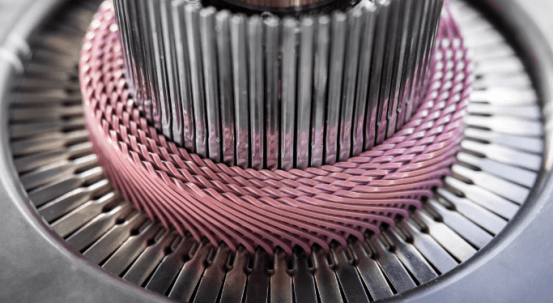
However, these advantages come at the cost of significantly increased manufacturing complexity. As a result, successful mass production of hairpin motor depends not only on motor design, but also on advanced automation equipment and integrated production systems.
This article provides an overview of the hairpin motor manufacturing process, the key automation technologies involved, and the broader automation equipment landscape, from a production and scalability perspective.
1. Why Hairpin Motors Are Becoming the Mainstream EV Technology
Hairpin motors are widely adopted in EV traction systems due to:
Higher efficiency and power density
Better thermal dissipation
Improved suitability for high-speed and high-voltage applications
Major OEMs and Tier 1 suppliers increasingly specify hairpin stators in their next-generation electric drive platforms. However, these benefits can only be realized at scale if the manufacturing process is stable, repeatable, and highly automated.
2. Core Hairpin Motor Manufacturing Process
2.1 Slot Insulation Insertion
The process begins with slot insulation to protect conductors from the stator core. At high production volumes, automation is essential to ensure:
Consistent insulation positioning
No damage to lamination edges
High cycle time stability
2.2 Hairpin Forming
Flat copper conductors are precisely bent into hairpin shapes. This step requires:
Tight dimensional control
Minimal surface damage
High repeatability
Advanced forming equipment ensures uniform geometry, which is critical for downstream insertion and welding quality.
2.3 Hairpin Insertion
Hairpin insertion is one of the most critical and technically demanding steps. Challenges include:
Accurate pin positioning
Avoiding insulation damage
Managing tight tolerances
Many manufacturers rely on fully automated hairpin insertion systems to achieve stable high-volume output.
2.4 End-Winding Forming and Welding
After insertion, the hairpin ends are formed and welded to create electrical connections. This stage directly impacts:
Electrical resistance balance
Thermal performance
Long-term reliability
Automated forming and welding systems with inline monitoring are essential for mass production.
2.5 Electrical Testing and Quality Control
Inline testing—including resistance, insulation, and dimensional checks—ensures defects are detected early, preventing costly downstream failures.
3. Automation Equipment Technologies for Hairpin Motor Production
Hairpin motor production relies on multiple categories of automation equipment:
Hairpin forming and insertion machines
End-winding forming and welding systems
Rotor assembly and magnet insertion equipment
Inline electrical and visual inspection systems
Rather than isolated machines, integrated production lines are increasingly preferred to ensure consistency, throughput, and traceability.
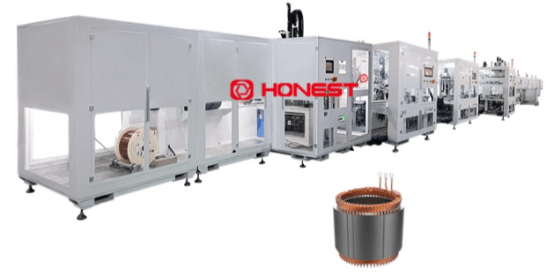
4. Overview of the Hairpin Motor Automation Equipment Landscape
From a manufacturing perspective, automation equipment providers can be broadly categorized into:
Single-process equipment specialists, focusing on individual operations such as forming or welding
Modular automation suppliers, offering configurable production modules
Turnkey production line integrators, capable of delivering complete hairpin stator and motor assembly lines
Each approach serves different production strategies and capacity requirements.
5. Honest Automation’s Role in Hairpin Motor Manufacturing
Honest Automation specializes in complete hairpin motor automation solutions, covering:
Hairpin stator winding and insertion
End-winding forming and welding
Rotor assembly and motor assembly
Inline testing and data traceability
By focusing on system-level integration, Honest Automation helps EV motor manufacturers bridge the gap between prototype development and high-volume production, ensuring scalability, yield stability, and long-term manufacturing reliability.
6. Key Considerations When Selecting Automation Equipment
When planning hairpin motor production, manufacturers should evaluate:
Scalability and future motor variants
Process stability and yield performance
Level of automation and labor dependency
System integration and data traceability
Experience of the automation partner in EV motor production
Early alignment between motor design and manufacturing system design is critical for successful industrialization.
Hairpin motor represent the future of high-performance EV drive systems, but their complexity demands advanced, well-integrated automation solutions. Understanding the manufacturing process and automation equipment landscape enables manufacturers to make informed decisions and avoid costly scaling challenges.
With its expertise in hairpin motor production lines and system integration, Honest Automation supports global EV manufacturers in achieving efficient, reliable, and scalable mass production.
Frequently Asked Questions About Hairpin Motor Manufacturing
Q1: Why is hairpin motor manufacturing more complex than round-wire motors?
A: Hairpin motors require precise forming, insertion, and welding of flat copper conductors, which significantly increases process complexity and tolerance requirements.
Q2: What equipment is required for hairpin motor mass production?
A: Hairpin forming machines, insertion systems, welding equipment, inline inspection, and integrated automation lines are essential.
Q3: How do manufacturers scale hairpin motor production efficiently?
A: By adopting fully automated, integrated production lines with real-time quality monitoring and data traceability.
Q4: What role do automation partners play in EV motor manufacturing?
A: Automation partners like Honest Automation provide system-level solutions that ensure consistency, scalability, and production efficiency.