Structural Types of Coreless Motor Windings
Coreless motor armature cups typically adopt three winding configurations: straight winding, skewed (honeycomb) winding, and diamond winding. Each design differs in slot fill factor, structural uniformity, manufacturability, and dimensional control.
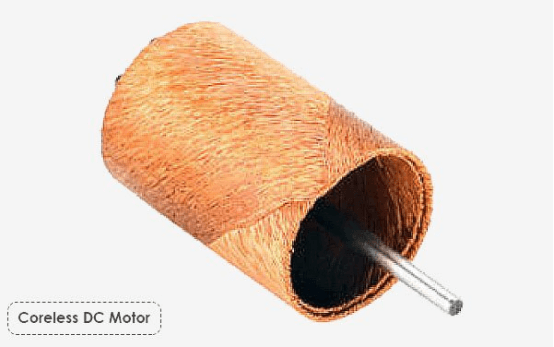
1. Straight Winding
Straight winding refers to a configuration in which the effective conductor sections are parallel to the armature axis. It is classified as a concentrated winding.
During manufacturing, enamelled copper wire is first wound into a circular coil according to the required number of turns. The coil is then expanded and arranged on a winding mandrel to form the developed armature cup. Both ends are bonded with adhesive and cured to maintain the structure.
Characteristics:
High slot fill factor
Thick wall structure in the mid-section of the winding cup
Irregular wire arrangement due to overlapping during winding
Higher-end height, since extra wire length must be reserved for lead routing
While this method provides good copper utilisation, the overall winding distribution tends to be less uniform.
2. Skewed Winding (Honeycomb Winding)
Skewed winding, also known as honeycomb winding, uses a continuous winding method where conductors are wound at a specific inclined angle relative to the armature axis. A central shaft opening is reserved during winding.
A dedicated winding mandrel is required, typically equipped with two rows of pins arranged according to the developed winding layout. The mandrel’s outer diameter defines the inner diameter of the armature cup, and the axial spacing of the pins determines the cup length.
During operation, the mandrel rotates and reciprocates on a manual or automated winding machine, allowing the enamelled wire to form the honeycomb pattern.
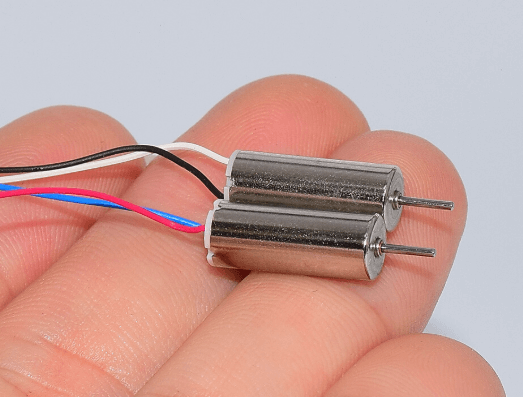
Characteristics:
Smaller end dimensions
Continuous winding process
Lower slot fill factor due to angular wire crossing
Some conductor overlap caused by the skewed layout
This design improves compactness at the end region but sacrifices copper density compared to straight winding.
3. Diamond Winding
Diamond winding uses a pre-formed coil approach. Self-bonding enamelled wire is first wound on a dedicated forming mold, then shaped and arranged multiple times to form the final armature cup.
During assembly, the two layers of conductors are neatly aligned and fixed in position, allowing precise dimensional control after forming.
Characteristics:
Neat and uniform conductor arrangement
Higher slot fill factor
Improved dimensional consistency
High production efficiency
Suitable for mass production
Diamond winding is widely preferred for large-scale manufacturing due to its structural stability and repeatability.
4. The winding process is the core technical barrier in coreless motor manufacturing
Coreless Motors vs. Iron-Core Motors: Performance Advantages and Manufacturing Complexity
Compared with conventional iron-core motors, coreless motors offer significantly superior performance, but their manufacturing process is considerably more complex.
The most critical step in coreless motor production is the winding of the cup-shaped armature coil. Self-bonding enamelled copper wire must be tightly and precisely arranged to form a structurally stable and geometrically accurate cup-shaped winding ultimately.
Coreless Motor Winding Methods
Currently, there are three main production methods for coreless motor windings:
(1) Manual Winding
Manual winding involves a series of intricate operations, including:
Pin-based positioning
Manual wire winding
Manual wire arrangement and alignment
This method is labor-intensive, highly dependent on operator skill, and offers limited production efficiency.
(2) Semi-Automated Production (Traditional Process)
The conventional semi-automated process involves:
Sequentially winding enamelled wire onto a specially shaped main shaft.
Removing the wound coil once the required length is achieved.
Pressing and forming the coil.
Finally shaping it into a cup-type armature winding.
This method improves consistency compared to manual production but still requires multiple intermediate steps.
(3) One-Step Automated Forming Technology
The most advanced approach is single-step automated forming.
In this process:
A single enamelled wire is automatically wound in a programmed pattern onto a mandrel.
The winding is directly formed into a cup structure.
The completed coil is removed, finishing the winding in one integrated process.
This method significantly enhances precision, consistency, and production efficiency.
Core Technical Barrier: Winding Technology
The winding process represents the primary technical barrier in coreless motor manufacturing.
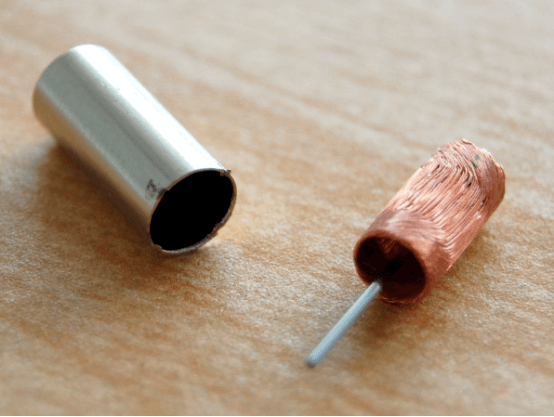
The production workflow is highly complex and substantially more demanding than that of traditional iron-core motors. A standard manufacturing process may involve nearly 30 procedures, including:
Front-end coil winding
Mid-stage assembly of bearings, mandrels, and support rings
Rear-end installation of the back cover
PCB welding and electrical connections
Among these steps, coil manufacturing is one of the most critical processes, directly determining motor performance and yield rate.
Domestic vs. International Manufacturing Gap
Most Chinese manufacturers currently rely on the wound-and-formed production method, whereas leading international companies predominantly use single-step automated forming technology.
This difference stems from:
More mature end-winding process development abroad
Higher levels of automation
Greater investment in precision equipment
As a result, international manufacturers typically achieve:
Higher automation levels
Greater production efficiency
Wider wire diameter ranges
Superior coil quality and tighter winding arrangement
Broader product portfolios and better overall motor performance
4. Coreless motors are increasingly becoming the preferred solution in applications requiring ultra-fast servo response, stable and continuous drive performance, as well as in aerospace systems—representing a key future development trend.
With the rapid advancement of industrial technologies, increasingly stringent performance expectations are being placed on coreless motors. Higher requirements in precision, response speed, efficiency, and reliability have made coreless motors indispensable in many advanced applications.
Coreless motors are becoming a key development trend in:
High-response servo systems requiring rapid acceleration and deceleration
Products demanding smooth, stable, and long-duration drive performance
Aerospace applications, including aviation systems, spacecraft, and model aircraft
A wide range of consumer electronics and industrial equipment
Thanks to their fast dynamic response, high energy density, low inertia, and smooth operation, coreless motors are increasingly viewed as irreplaceable solutions in high-performance motion control systems.
Honest Automation offers complete assembly line solutions for coreless motors, including prototyping and small-batch production. If you are interested in exploring high-precision coreless motor assembly or discussing customized solutions, we warmly welcome you to contact us or visit our facility for a consultation.
Browse Our Coreless Motor Winding Machine Case Studies