1. Electric Motors: The Core Power Behind Humanoid Robots
Electric motors serve as the primary power source of humanoid robots. The actuator is the key component that enables robots to generate motion. Based on the transmission mechanism, actuators in the robot’s torso can generally be classified into rotary actuators and linear actuators.
An actuator (often referred to as an integrated robotic joint) converts the rotational motion of the motor into the movement of a linkage mechanism. It is the core power unit that enables robots to perform various actions. As the central component within the actuator, the electric motor converts electrical energy into mechanical energy, providing the driving force required for the robot’s overall motion.
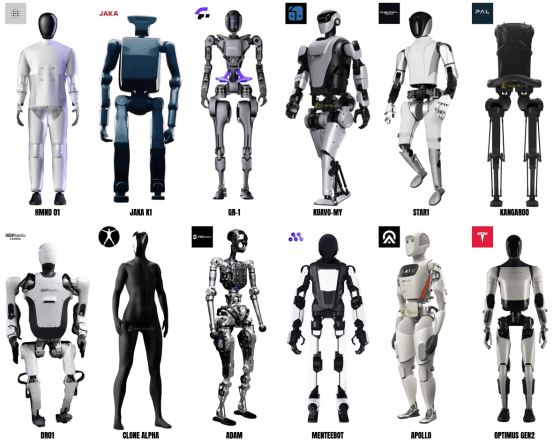
Actuators used in the torso of humanoid robots can therefore be divided into two main categories: rotary actuators and linear actuators. The key difference lies in their transmission mechanisms. Rotary actuators typically use gear reducers, while linear actuators commonly adopt planetary roller screws.
For example, the humanoid robot Tesla Optimus is equipped with 14 linear actuators and 14 rotary actuators throughout its body. These actuators work together to enable precise and flexible motion control. In addition to body joints, dexterous robotic hands also rely on electric motors to drive finger movements and enable complex manipulation tasks.
2. Motor Performance Is Critical for Humanoid Robots
Electric motors are among the most critical components in humanoid robots, and their performance directly affects the robot’s mobility, flexibility, stability, and energy efficiency.
The peak torque of a motor provides the power required for load-bearing tasks and complex motion execution. It forms the foundation for capabilities such as heavy-load operations, obstacle traversal, and dynamic movement.
Meanwhile, high torque density—the combination of lightweight design and strong power output—significantly improves the robot’s motion agility while reducing energy consumption, thereby helping extend the robot’s operational endurance.
In addition, the output precision and stability of the motor are essential for achieving smooth walking, precise manipulation, and dynamic balance. From fine motor control in delicate movements to posture adjustments in complex environments, reliable motor response is crucial for stable robot performance.
The performance requirements for motors in humanoid robots are continuing to rise. Looking at the core parameters of joints used in several leading humanoid robots—such as Unitree H1, Unitree G1, Tesla Optimus, and Zhiyuan Lingxi X1—two key trends can be observed.
First, higher power output is increasingly required. For example, the knee joint motor of the Unitree H1 can deliver a peak torque of up to 360 N·m, providing the necessary power for complex movements and heavy-load tasks.
Second, lightweight design and energy efficiency are becoming more critical. The torque density of the Unitree H1 and Zhiyuan Lingxi X1 reaches 189.5 N·m/kg and 156.3 N·m/kg, respectively. This reflects a key engineering challenge: motors must maintain low weight while delivering higher power output efficiency. As a result, motor efficiency directly impacts the battery life and operational endurance of humanoid robots.
3. Motors Are the Core Components of Actuators, Enabling Energy Conversion Through Electromagnetic Induction
Electric motors are electrical devices that convert energy or signals through the principle of electromagnetic induction. Depending on their function or structural design, these machines can be classified into several types, including generators and electric motors.
4. Motor Torque and Rotation Are Generated by the Interaction Between Magnetic Fields and Electric Current
Motor rotation results from the periodic attraction and repulsion between the stator and rotor magnetic fields, and its performance is influenced by multiple factors such as the number of coil turns and the magnetic flux.
When electric current flows through the stator windings, magnetic fields are generated that interact with the magnets in the rotor. The motor rotates by utilizing the repulsive force between identical magnetic poles and the attractive force between opposite poles.
By controlling the direction of current in the stator windings, the stator magnetic field is sequentially switched, causing the rotor—typically equipped with permanent magnets—to rotate continuously.
The magnitude of the electromotive force (EMF) and the resulting torque are determined by factors such as the number of coil turns and variations in magnetic flux.
5. A Key Breakthrough for Humanoid Robot Performance: Increasing Power and Torque Density
Under the constraint of limited internal space within humanoid robots, improving motor power density and torque density has become a critical approach to enhancing overall robot performance as well as the gripping capability of dexterous robotic hands.
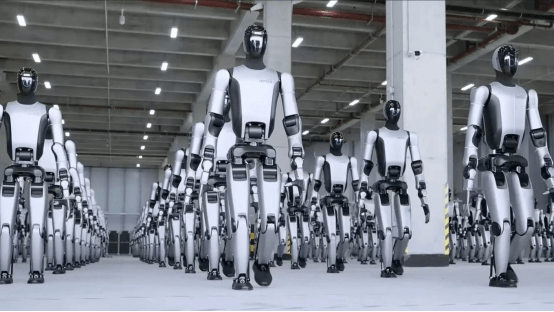
According to the D²L rule, motor torque increases proportionally with the length of the stator lamination stack, or with the square of the motor’s torque arm diameter. In practical terms, this means that increasing either the stack length or the effective motor diameter can significantly improve torque output.
The peak torque capability of the motor directly determines the overall dynamic performance of humanoid robots. However, insufficient power density remains a key factor limiting the maximum gripping force of dexterous robotic hands.
Therefore, achieving higher motor power and torque density within limited space constraints has become one of the most important technological directions for advancing the overall performance of humanoid robots.
6. High-Efficiency Motors Are Essential for High-Performance Robot Joints: Focusing on Efficiency, Dynamics, and Power Density
High-performance joint actuators rely on high-efficiency motors, typically evaluated across three key dimensions: efficiency, dynamic performance, and power density.
High Efficiency:
Low energy consumption and minimal friction losses are critical, as humanoid robots are typically battery-powered and must operate efficiently under demanding conditions. Motors must withstand frequent forward and reverse rotation, rapid acceleration and deceleration, and short-term overloads while maintaining stable performance.
High Dynamic Performance:
The overall inertia of the entire drive system—including the motor, transmission mechanism, wiring, sensors, and controller—should be kept as low as possible. In addition, the response time from receiving a command signal to reaching the required operating state should be extremely short, ensuring fast and precise motion control.
High Power Density:
Robotic applications require motors capable of delivering high speed and high torque simultaneously. At the same time, the motor must remain compact, lightweight, and highly integrated to fit within the limited space of robotic joints and limbs.
7. Axial Flux Motors: Motors with Axial Magnetic Flux and Disc-Shaped Design Advantages
Axial flux motors redirect the magnetic flux along the motor’s axis and position the rotor adjacent to the stator, achieving higher power density and increased design flexibility. Also known as disc motors, axial flux motors feature a magnetic flux path that differs from conventional radial flux motors. Their air gap is planar, with the magnetic field direction parallel to the motor shaft.
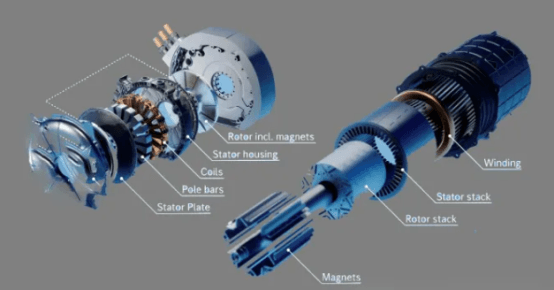
The most notable structural distinction from traditional motors is that the rotor is located on the side of the stator rather than enclosed within it. This arrangement allows the rotor diameter to be significantly increased, resulting in higher torque density and greater structural flexibility, making axial flux motors a key technology for the next generation of high-performance drive systems.
Axial flux motors can adopt various structural configurations based on the combination of stator and rotor, each offering specific advantages in power density, mechanical stress characteristics, and application suitability:
Single Stator / Single Rotor: Consists of one stator and one rotor. The structure is simple and compact, but may suffer from high unbalanced magnetic pull, increased bearing load, noticeable vibration and noise, and rotor-stator friction, which can affect motor lifespan.
Single Stator / Double Rotor: Composed of one inner stator and two outer rotors. This configuration achieves high power density and allows greater torque output within limited space, making it suitable for traction systems, aerospace, and other applications requiring high performance density.
Double Stator / Single Rotor: Consists of one inner rotor sandwiched between two stators. Its structural symmetry effectively reduces unbalanced magnetic pull, making it ideal for applications like wind turbines and other systems requiring stable operation.
Multi-Stator / Multi-Rotor: Multiple stators and rotors are stacked together to achieve extremely high torque output, suitable for marine propulsion, large wind turbines, and hydroelectric generators.
Because torque in axial flux motors is proportional to the cube of the rotor diameter, under the same material and rotational speed conditions, these motors can achieve up to four times the torque of conventional radial flux motors.
8. PCB Stator Motors: Enabling Lightweight, High-Efficiency, and High-Reliability Design
PCB stators leverage a coreless design to significantly reduce both the size and weight of the motor, while also lowering losses and improving efficiency and reliability. Unlike conventional motors, PCB stators etch copper windings directly onto a printed circuit board, which can reduce the motor’s weight and dimensions by approximately 50%.
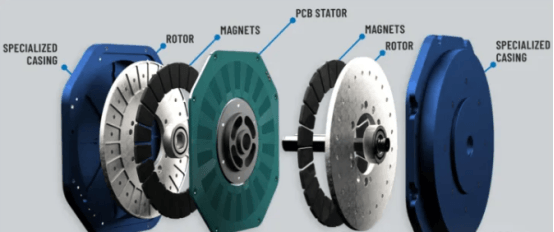
In electric vehicle powertrains, the drive current from the traction inverter flows through the fixed PCB stator windings, generating axial magnetic flux that drives the rotor rotation, propelling the vehicle forward.
Beyond the advantages of compact size and lightweight design, the coreless configuration substantially reduces stator hysteresis losses and eddy current losses, improving overall energy efficiency and mechanical output per unit of electrical input.
Moreover, by eliminating potential failure points associated with traditional copper windings and insulation, PCB stators enhance motor reliability, offering an innovative solution for lightweight, high-performance electric drive systems.
9. Harmonic Field Motors: Breaking the Pole-Pair Equality Constraint to Increase Torque
Harmonic field motors are a new type of motor that operates based on the principle of magnetic field modulation. In these motors, the number of pole pairs in the excitation (field) unit and the armature (rotor) unit are unequal, requiring an additional modulation unit to convert the pole pairs. This unique electromagnetic phenomenon is referred to as the “magnetic field modulation effect.”
Under this effect, the external characteristics of a harmonic field motor resemble those of a mechanical reduction gearbox, introducing an amplification factor known as the “pole ratio”. As a result, the motor can achieve significantly higher torque density under the same material selection and thermal constraints, offering broad application potential in high-performance robotics, aerospace, and other advanced electromechanical systems.
10. Ultrasonic Motors: Self-Locking and High-Precision Drives with Potential Applications in Dexterous Hands
Ultrasonic motors (USMs) are a novel type of actuator that utilize the inverse piezoelectric effect of piezoelectric materials.
A typical ultrasonic motor consists of a stator, rotor, and a preloading mechanism. When an ultrasonic-frequency alternating voltage is applied to the piezoelectric ceramics, ultrasonic vibrations are generated on the stator surface. These vibrations, combined with the friction between the stator and rotor, drive the rotor’s motion.
Compared to traditional electromagnetic motors, ultrasonic motors offer several key advantages:
High torque at low speed without the need for a reduction gear.
Excellent quiet operation, as no mechanical reduction gears are required.
Self-locking capability, providing holding torque when unpowered.
Immunity to magnetic interference, with no generated electromagnetic field.
Compact and lightweight design, ideal for space-constrained applications such as dexterous robotic hands.
11. Other Motor Technologies
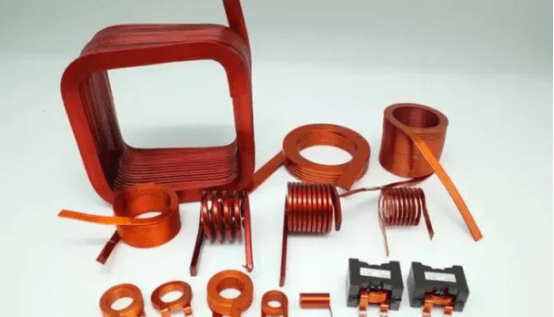
Flat Wire Windings: Enhancing Power, Efficiency, and Reliability
Flat wire windings achieve higher power output, improved efficiency, and better thermal and voltage endurance through high slot fill ratios, optimized thermal management, and advanced winding geometry. This makes them well-suited for applications requiring compact, high-performance motors.
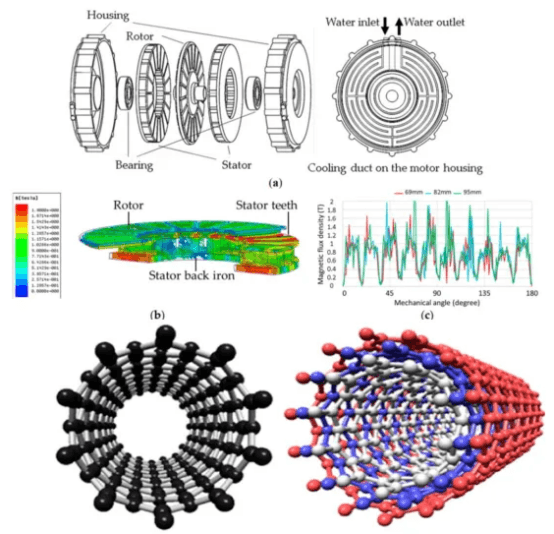
12. Advanced Materials: Liquid Cooling, Carbon Nanotubes, and Emerging Heat Management Solutions
The integration of liquid cooling channels, carbon nanotube thermal conduction, and phase-change materials significantly improves motor heat dissipation, enabling stable operation at high power densities and enhancing overall performance in demanding applications.
13. Dexterous Robotic Hands: The Most Critical End-Effector of Humanoid Robots
Currently, most dexterous robotic hands on the market rely on coreless motors, brushless slotted motors, and miniature frameless motors to achieve high-precision finger actuation and flexible manipulation. These motor solutions allow robotic hands to perform complex grasping and manipulation tasks with reliability and responsiveness.
Coreless (Hollow Cup) Motors: Advantages
Key Features:
Slotless design (no cogging effect)
Compact structure
Low inductance
Advantages:
Smooth operation at low speeds
Low vibration and low noise
Rotor position can be precisely controlled at any angle
Optimized magnetic circuit design
Higher power density
Low temperature rise and high efficiency
High dynamic response
Capability for high acceleration
14. Miniature Frameless Motors: Integrated Design for Compact Spaces and Efficient Cooling
Frameless motors provide an ideal solution for precise servo-driven motion control, commonly used in robotic end-effectors and joint actuators.
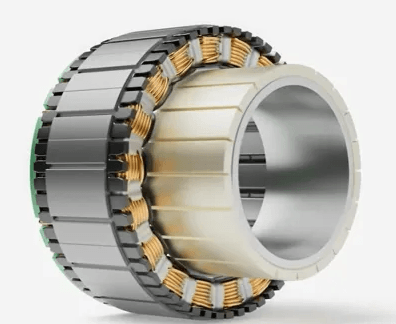
These motors have been streamlined to their essential components—the stator and rotor—eliminating traditional frames, bearings, and shafts. Thanks to this simplified structure, engineers can mount the frameless motor directly into a robot joint or end-effector, transmitting the required torque efficiently.
Frameless motors support flexible axial lengths, while radial dimensions can be customized to fit the joint cavity. They even allow radial mounting or hollow-through designs, enabling highly compact integration.
This flexibility empowers engineers to “create joints” rather than merely adapting motors, providing unprecedented freedom in robotic design and improving heat dissipation and overall performance in confined spaces.
Honest Automation provides complete humanoid robot assembly lines and a wide range of motor assembly equipment for various types of robot motors, including frameless torque motors, coreless (hollow cup) motors, and joint motors.
Whether you need prototyping or small-batch production, we offer customized solutions tailored to your requirements. With multiple successful client collaborations, our technology has been market-validated, ensuring stable production and high-quality output that meets customer expectations.
For inquiries or to discuss your humanoid robot motor assembly needs, feel free to contact us for a personalized solution.