By 2025, the penetration rate of hairpin motors in the new energy passenger vehicle market is expected to exceed 80%, and this is projected to rise to over 90% by 2026-2027. Alongside the surge in market demand, another trend is emerging: the diversification of vehicle models and the fragmentation of stator specifications. Different automakers and vehicle models have varying requirements for stator parameters such as inner and outer diameter, number of slots, number of layers, and pin angle shape. This means that the hairpin motor assembly line must not only be fast but also highly flexible, capable of frequent changes to accommodate the diverse needs of different vehicle models.
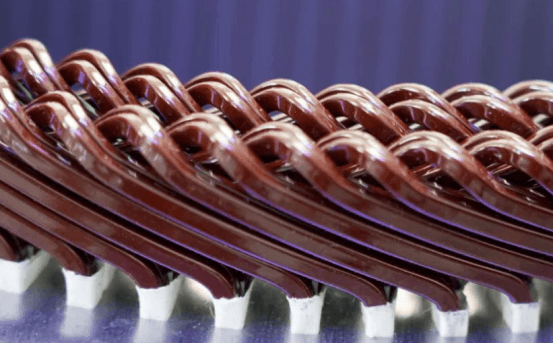
Against this backdrop, the cutting and twisting process, as one of the key steps in hairpin stator manufacturing, has become a bottleneck in the overall production line efficiency.
Why is the transition from cutting to non-cutting a necessity?
Before answering this question, let’s first look at the three major drawbacks of the traditional cutting process.
The traditional hairpin stator winding process typically follows this path: twisting → cutting → welding.
The "cutting" process is designed to ensure the ends are flush, meeting the requirements for subsequent welding. However, this process introduces three significant issues that cannot be overlooked:
1. Copper Shavings Risk: The cutting process generates copper shavings. For high-voltage or drive motors, if copper shavings enter the stator, they can cause damage to the insulation, lead to insulation failure, or even result in a short circuit and burnout.
2. Additional Labor and Cost: Cutting requires the addition of a dedicated machine, material handling (loading/unloading), and waiting time. In the overall production line cycle, this process takes anywhere from a few seconds to more than ten seconds.
3. Difficulty in Ensuring Size Consistency: Cutting involves inherent tolerances in the machining process, and tool wear further affects the alignment. For multi-layer hairpin stators (such as 6-layer, 8-layer, or 10-layer), it is often difficult to consistently maintain the end height within the range required for the welding process.
Based on the issues mentioned above, the core principle of the "non-cutting" technology is to optimize the twisting trajectory and mold design, allowing the ends of the hairpin motor stator to naturally align after twisting, eliminating the need for subsequent cutting.
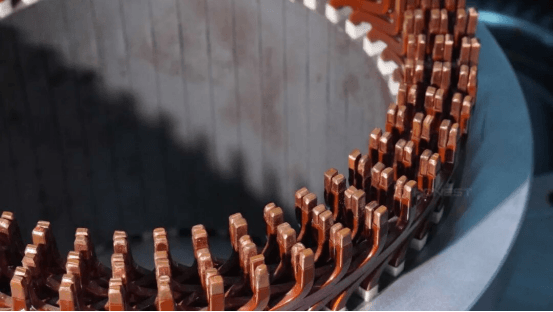
The value of the "non-cutting" technology is straightforward: it eliminates the cutting process, removes the risk of copper shavings, and improves size consistency.
Manual Mold Changing is Often Overlooked, But it is Actually an Efficiency Black Hole
Although the "non-cutting" technology resolves the cutting issue, there is still another efficiency bottleneck in the process—manual mold changing.
Let’s walk through a real-life manual mold changing scenario:
After completing a batch of stators of model A, the next batch is model B. Due to differences in wire diameter, number of slots, number of layers, and twisting angle, the machine must be stopped. The operator needs to unscrew bolts, remove the old mold, install the new mold, align it, perform a test twist, and adjust parameters.
This entire process takes anywhere from 30 minutes to an hour.
What’s even more troublesome is that changing molds 3 to 5 times a day is not uncommon.
Let’s do the math: assuming each mold change takes 45 minutes, and 4 mold changes are made in one day, that’s 3 hours of pure downtime. Add to that the waste from test twists (3% to 8%), and the labor management costs associated with relying on experienced operators, and the time saved by non-cutting technology is ultimately consumed by manual mold changing.
At this point, pause for a moment and ask yourself: How many times a day does your production line change molds?
The cost of manual mold changing has been calculated. So, what if we could automate this step as well?
Automated Mold Changing with a Robotic Arm
First, let's clarify a key point: winding speed is not the only factor in efficiency.
Imagine two hairpin winding machines with the same winding speed. However, one requires manual mold changing, with each mold change taking 60 minutes for the operator to disassemble, align, and test the twist.
The other machine has an additional automated mold changing process, where a robotic arm automatically swaps the molds, with each change taking only 3 minutes. In a production scenario where mold changes occur 4 times a day, the second machine offers nearly 4 more hours of effective production time.
This is the real source of the efficiency gap.
In simple terms, a non-cutting hairpin machine without automated mold changing only saves "cutting time," but the "mold changing time" remains. By adding an automated mold changing process to the non-cutting technology, we replace manual labor with a robotic arm, eliminating the "mold changing time."
Only when both are combined does the true efficiency gain in the winding process emerge.
Therefore, in response to the diverse and high-frequency mold change demands of hairpin motor production, Honest Automation has pioneered the integration of automated mold changing into the mass production solution based on the non-cutting winding machine.
Next, let's break down its core advantages from the following five dimensions.
1. Compatible with Multiple Mainstream Wire Types, Wide Coverage
The equipment supports popular hairpin motor wire types currently on the market, including X-pin, MINI-pin, and H-pin. Stators of various types, slot numbers, and layer counts can all be twisted on the same machine, eliminating the need for dedicated equipment for each wire type.
2. Automated Mold Changing, Significantly Reduced Mold Change Time
The mold changing process is highly simplified. The operator simply presses the mold change button, and the robotic arm automatically removes the current mold and replaces it with another set. The entire process requires no manual screw removal, no alignment, and no test twisting.
3. Wide Stator Size Range with Customization Support
The Honest Automation non-cutting, automated mold-changing winding machine covers a stator inner diameter range of 120-200mm and an outer diameter of ≤300mm. If your stator dimensions fall outside this range, we offer custom solutions to flexibly meet the diverse needs of different customers.
4. Independent Twisting for Each Layer, High Precision and Easy Setup
For multi-layer hairpin motor stators (such as 6-layer, 8-layer, and 10-layer), each layer often requires different twisting angles and trajectories. In traditional integrated twisting molds, adjusting one layer affects the entire process, making tuning complex and precision hard to ensure.
Honest Automation’s equipment features independent twisting for each layer: the twisting parameters for each layer can be set and controlled separately. Process engineers can optimize each layer individually without compromising the others. Moreover, the end flush tolerance after twisting is minimal, providing excellent conditions for subsequent welding.
5. High Flexibility, Low Overall Cost
A single machine can accommodate multiple stator models, which means:
No need to invest in dedicated twisting equipment for each model → Saving on equipment costs.
Short mold change time, low scrap rate → Profitable even for small-batch orders.
Ideal for multi-variety production lines, R&D prototypes, and small-batch quick-response production.
Overall, the addition of an automated mold changing process to the non-cutting hairpin stator twisting machine not only addresses the process optimization issues brought by the "non-cutting" technology but also solves the flexible production challenge of "how to change molds quickly" by replacing manual mold changing with a robotic arm.