1. What Is a Hairpin Motor?
A hairpin motor is a new-generation traction motor that uses rectangular flat copper wire in the stator windings instead of traditional round copper wire. Due to the hairpin-shaped conductors used in the winding process, it is also commonly known as a hairpin stator motor or hairpin winding motor.
Its key advantages include a higher slot fill factor, improved heat dissipation, and greater power density, making it the preferred and mainstream technology for electric vehicle (EV) drive motors today.
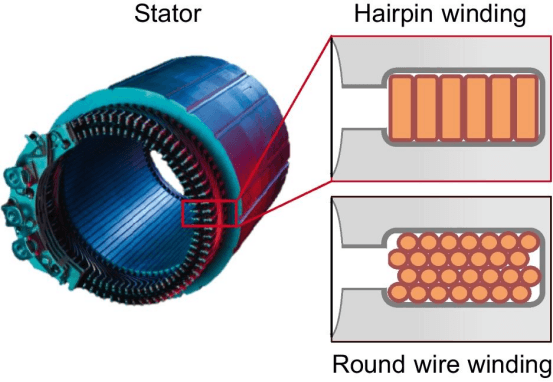
A hairpin motor refers to a permanent magnet synchronous motor (PMSM) that uses rectangular enameled copper wire in its stator slots. Compared with conventional round-wire windings, hairpin windings significantly increase the copper fill factor within the slots, achieving a slot fill rate of over 70%.
This higher copper utilization effectively reduces winding resistance and copper losses, resulting in improved motor efficiency. As a result, hairpin motors are particularly well-suited for applications requiring high continuous power output, such as electric vehicle traction systems.
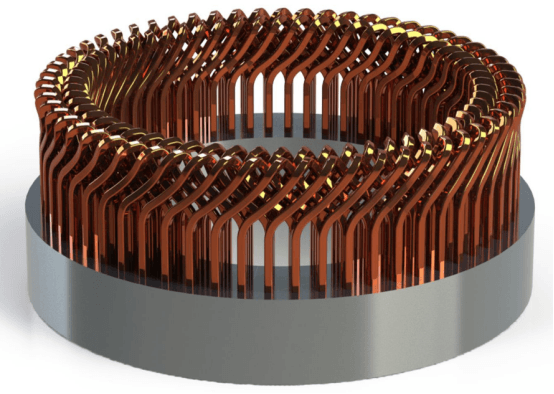
A hairpin motor refers to a permanent magnet synchronous motor (PMSM) that uses rectangular enameled copper wire in its stator slots. Compared with conventional round-wire windings, hairpin windings significantly increase the copper fill factor within the slots, achieving a slot fill rate of over 70%.
This higher copper utilization effectively reduces winding resistance and copper losses, resulting in improved motor efficiency. As a result, hairpin motors are particularly well-suited for applications requiring high continuous power output, such as electric vehicle traction systems.
Hairpin winding is not the traditional helical winding; instead, it follows a preforming + insertion + welding process:
Wire Preforming: The flat copper wire is precisely cut, stripped of enamel, and formed into hairpin shapes (Hair-pin), I-pin shapes, or continuous wave patterns.
Wire Insertion: The preformed hairpins are inserted layer by layer into the stator slots.
End-Turning (Bending): The protruding wire ends are twisted and shaped to form a stepped arrangement for the required electrical connections.
Laser Welding: The bent wire ends are welded together using laser welding to form a complete stator winding circuit.
This process is highly automated and places strict demands on the precision and cycle time of specialized machines for insertion, flaring, end-turn bending, and welding.
Hairpin motors feature a compact structure and are mainly composed of the following components:
Stator Core and Windings: Commonly configured with 4-, 6-, or 8-layer hairpin windings, with the winding ends connected phase-to-phase via busbars.
Rotor Assembly: Equipped with high-performance permanent magnets, working together with the hairpin stator to achieve high torque density.
Cooling System: Typically uses an oil-cooling design, where the cooling oil comes into direct contact with the winding ends, providing significantly higher heat dissipation efficiency than conventional water cooling.
Housing and Insulation System: Includes high-temperature-resistant insulation paper, varnishing, or resin impregnation to ensure high-voltage safety.
2. What Is a Hairpin Stator?
A hairpin stator is the stationary part of a hairpin motor that uses pre-formed rectangular copper conductors (hairpins) instead of traditional round wires. It is the core component of a hairpin motor, directly enabling higher slot fill factor, improved cooling, and greater power density for electric drive systems.
Hairpin Stator Components
Core
Laminated electrical steel stack with open slots that house the hairpin conductors and guide magnetic flux.
Hairpin Conductors
Rectangular copper wires shaped like hairpins, inserted axially into the slots and arranged in multiple layers (e.g., 4, 6, or 8 layers) to maximize copper fill.
Insulation
Includes slot liners, phase separators, and final impregnation resin to ensure reliable electrical isolation between conductors and core.
Welding Joints
Laser-welded connections at the twisted conductor ends that complete the winding circuit with high electrical and mechanical integrity.
The hairpin stator is the core component of a hairpin motor, determining its torque density, efficiency, and thermal behavior.
3. Hairpin Motor vs Conventional Wound Motor
When comparing hairpin motors to conventional round-wire wound motors, the hairpin stator delivers clear performance and manufacturing advantages. The table below highlights the key differences, often searched as “Hairpin Motor vs Round Wire Motor.”
Feature | Hairpin Motor | Conventional Wound Motor |
Slot Fill Rate | 70%–80% | 40%–50% |
Efficiency | Higher (reduced I²R losses) | Lower |
Power Density | Higher (more torque per volume) | Lower |
Automation | Easier (axial insertion + laser welding) | More difficult (needle/shedding winding) |
Key Advantages Explained:
Slot Fill Rate – Rectangular hairpin conductors pack tightly into slots, eliminating the air gaps inherent in round-wire windings. This directly increases the copper cross-section within the same slot area.
Efficiency – Higher copper fill means lower winding resistance, which reduces heat generation and boosts motor efficiency, especially under sustained high-load operation.
Power Density – With lower losses and better heat conduction from flat conductors to the stator core, hairpin motors achieve higher continuous power output and torque density—critical for electric vehicle traction.
Automation – The hairpin process relies on pre-formed wires, straight-line insertion, precision twisting, and laser welding. This linear flow is far easier to automate at scale than the complex, three-dimensional movement required for conventional winding.
These hairpin stator advantages—higher slot fill, superior efficiency, greater power density, and mass-production-ready automation—explain why the hairpin motor has become the dominant choice for next-generation electric drive systems.
4. Hairpin Stator Manufacturing Process
The hairpin stator manufacturing process is a fully automated, sequentially engineered flow designed for high-precision mass production. Each station directly impacts the final efficiency and reliability of the hairpin motor.
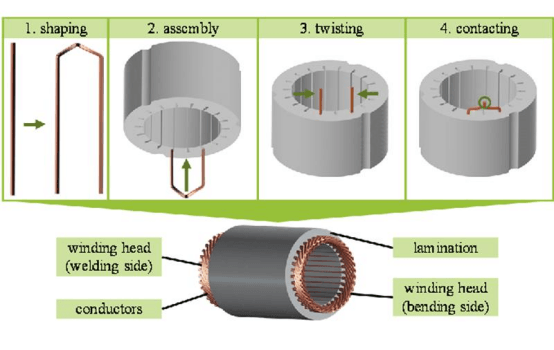
Hairpin Forming → Hairpin Insertion → Twisting → Welding → Inspection → Assembly
The hairpin winding process begins with flat copper wire, which is straightened, stripped of insulation at defined zones, cut to length, and precision-formed into U-shaped hairpins. Highly automated forming machines ensure consistent geometry, a prerequisite for smooth downstream insertion.
Pre-formed hairpins are axially inserted into the stator core slots layer by layer. This station includes automatic wire guiding, slot liner protection, and often an initial spreading function. A smooth insertion process is critical to avoid insulation damage and maintain the high slot fill rate.
The exposed ends of the inserted hairpins are precisely twisted in opposite directions to create the required phase connections. This CNC-controlled twisting station achieves the exact stepped arrangement necessary for reliable welding, which is central to any hairpin stator production line.
Laser welding joins the twisted hairpin ends, forming the continuous winding circuit. The process demands high positional accuracy and real-time energy control to produce low-resistance, mechanically robust joints without damaging nearby insulation.
In-line inspection verifies every critical quality point using high-speed vision systems, electrical testing (resistance, surge), and sometimes thermal imaging. This station guarantees zero-defect flow in hairpin stator manufacturing, catching forming or welding inconsistencies immediately.
The final hairpin stator assembly stage integrates the welded stator with busbars, terminal connections, and insulation impregnation (trickle or full dip). After curing, the completed hairpin stator is ready for rotor pairing and final motor integration.
From wire forming to final assembly, this linear hairpin stator manufacturing process delivers the repeatable quality and throughput required for high-volume electric vehicle production.
5. Challenges in Hairpin Motor Manufacturing
Scaling hairpin motor production requires solving several precision engineering challenges. Even minor deviations can lead to scrap, rework, or compromised performance. The following are the most critical hairpin motor manufacturing challenges and the focus areas for advanced automation.
Hairpin Forming Accuracy – Rectangular copper conductors must be formed to tight geometric tolerances without damaging the insulation or introducing micro-cracks. Inaccurate bending or cutting leads to insertion interference and twisting misalignment, directly affecting downstream yield.
Insertion Consistency – Axially inserting hundreds of hairpins into the stator core demands precise motion and delicate force control. Any inconsistency can scratch the slot liners, displace the insulation paper, or reduce the slot fill uniformity, ultimately risking short circuits or thermal hotspots.
Welding Quality – Laser welding of twisted hairpin ends must produce consistent, low-resistance joints with minimal spatter and heat-affected zones. Defects such as porosity, incomplete fusion, or excessive burn-back are major sources of rejection in mass production and can cause early field failures.
Insulation Reliability – The entire system relies on multiple insulation layers: slot liners, wire enamel, phase separators, and impregnation resin. Mechanical damage during forming, insertion, or twisting, along with voids during impregnation, creates partial discharge risks that are unacceptable in high-voltage traction applications.
Mass Production Efficiency – Balancing cycle time with precision is extremely difficult. Every station—forming, insertion, twisting, welding—must run at high speed without sacrificing quality, and line-wide data feedback is essential to maintain overall equipment effectiveness (OEE) for profitable hairpin stator production.
Overcoming these challenges requires purpose-built hairpin manufacturing equipment with integrated inline inspection and adaptive control. As a specialist in motor automation, we design our forming, insertion, twisting, and laser welding stations to address these exact pain points, enabling customers to achieve stable, high-yield serial production.
6. Hairpin Motor Production Line Solution
HONEST Automation delivers complete, turnkey hairpin motor manufacturing solutions — from single stations to fully integrated production lines. Designed for high-volume electric vehicle traction motor production, our systems combine precision mechanics, advanced laser technology, and intelligent process control to ensure high yield and repeatable quality.
Our modular hairpin stator production line covers every critical step:
Hairpin Forming Machine – Straightening, precise stripping, cutting, and 2D/3D bending to meet tight geometrical tolerances without damaging the copper or insulation.
Hairpin Insertion Machine – Automated slot liner placement, multi-layer axial insertion with servo-controlled force feedback, and initial wire expansion to protect insulation integrity.
Hairpin Twisting Machine – CNC-driven twisting units that create the exact stepped end-pattern required for consistent, reliable laser welding.
Hairpin Welding Machine – High-speed laser welding stations with real-time energy control and integrated vision inspection to eliminate defects such as porosity and burn-back.
Stator Assembly Line – Fully automated busbar assembly, terminal welding, trickle impregnation, and curing — all seamlessly integrated with robotic handling.
End-of-Line Testing System – Comprehensive electrical verification including surge, resistance, and partial discharge testing, plus dimensional checks, ensuring every stator meets specification before final motor assembly.
By addressing the key manufacturing challenges — forming accuracy, insertion consistency, and welding quality — HONEST Automation’s hairpin stator production solutions help manufacturers achieve fast ramp-up, high OEE, and the scalable output demanded by next-generation electric drive programs.
7. Hairpin Motor Production Line Customer Cases
HONEST Automation has established a strong track record by delivering complete hairpin stator and motor assembly solutions to major domestic and US-based customers. Our proven expertise spans the full range of pin-type motors, including hairpin, X-pin, mini pin, and I-pin configurations, as well as complete drive motor final assembly lines. From single stations to fully integrated turnkey systems, our lines are designed for high-speed, flexible mass production.
Key delivered solutions and performance highlights include:
Hairpin Stator Assembly Line (US Customer) – A high-speed line for a 48-slot, 6-parallel-wire, 12-layer hairpin stator, achieving a 45-second overall cycle time per stator. The integrated automatic slot paper insertion station operates at 1 second per slot, ensuring high OEE without bottlenecks.
BSG Stator Assembly Line & Traction Rotor Assembly Line (Domestic Customers) – Flexible platforms supporting stator slot counts of 48, 54, and 72, with quick changeover between hairpin, X-pin, and mini pin winding types. These lines combine insertion, twisting, and laser welding in a fully automated flow.
Standalone High-Speed Hairpin Forming Machine – Capable of producing formed hairpin conductors at a rate of 1 piece per second, maintaining tight bending tolerances and pristine insulation quality to feed high-volume production.
No-Cut Twisting Machine – Our proprietary twisting solution eliminates the traditional cutting step, directly improving weld joint consistency, reducing material waste, and simplifying the overall hairpin winding process.
With domain expertise covering hairpin stator manufacturing, BSG stator lines, drive rotor assembly, and standalone forming and twisting stations, HONEST Automation provides comprehensive, scalable solutions for next-generation electric drive production. Our ability to deliver 45-second cycle times for complex 6-wire, 12-layer, 48-slot stators—along with ultra-fast 1-second slot paper insertion and 1-piece-per-second forming—demonstrates the precision, speed, and reliability we bring to every customer project.
8. Applications of Hairpin Motors
Hairpin motor technology has moved from niche to mainstream, driven by the demand for higher efficiency and compact power. Its high slot fill factor and superior thermal performance make it the preferred choice across a broadening range of industries. Below are the key application areas capturing significant search and market interest.
EV Drive Motors – The primary application for hairpin motors. The technology directly extends vehicle range, improves acceleration, and supports 800V high-voltage systems, making it standard in next-generation battery electric vehicles.
Hybrid Vehicles – The compact size and high power density of hairpin motors are ideal for the tight engine-bay packaging of hybrid systems, including both full and plug-in hybrids, where electric-only range and fuel economy are critical.
Commercial Vehicles – Buses, trucks, and heavy-duty off-road machines benefit from the superior continuous-power output and robust thermal endurance of hairpin motors, enabling reliable operation under sustained high-load conditions.
Industrial Servo Motors – The growing need for high-precision, high-dynamic automation equipment is pushing the adoption of hairpin winding in servo motors, where low torque ripple and high overload capability are essential for robotics and CNC machining.
Aerospace Motors – The push for aircraft electrification, eVTOL, and UAV propulsion relies on the extreme power-to-weight ratio and high-efficiency performance of hairpin motors, where every gram of weight saved and every watt of heat dissipated matters.
From high-volume EV traction to low-volume, high-reliability aerospace applications, the hairpin motor's advantages drive its adoption. HONEST Automation's flexible manufacturing solutions are engineered to produce hairpin stators for all of these demanding fields, ensuring our customers can capture opportunities wherever the market is growing.
9. Hairpin Motor Manufacturers and Industry Trends
The adoption of hairpin winding technology has become a defining trend in the electric drive industry. Leading global manufacturers and Tier 1 suppliers have integrated hairpin motors into their core platforms, signaling a permanent shift away from conventional round-wire windings.
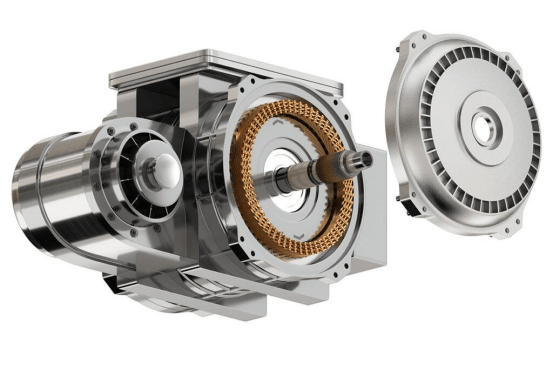
Key Manufacturers Driving Adoption
Tesla – Deployed hairpin stator technology in its latest drive units for Model 3 and Model Y, leveraging the higher continuous power output and automated manufacturability to meet Gigafactory-scale demand.
ZF – Launched a modular hairpin e-drive family spanning passenger cars to commercial vehicles, with a strong focus on compact design, 800V compatibility, and power density.
Bosch – Developed advanced hairpin motor solutions for both hybrid and full-electric applications, prioritizing efficiency optimization and cost-effective, scalable production.
Industry Trends
More and more new energy vehicles are adopting hairpin technology. Industry forecasts project that hairpin motor penetration in the global EV traction market will exceed 80% by 2030, driven by demands for extended range, faster charging, and lower per-unit costs. This shift extends well beyond automotive — industrial servo and aerospace sectors are now embracing hairpin stators for their unmatched power-to-weight ratios.
Key technical trends shaping the future of hairpin motor production include:
Higher layer counts: Moving from 4- and 6-layer to 8-, 10-, and even 12-layer hairpin designs for smoother torque delivery and higher voltage capability.
Advanced pin formats: Rapid evolution from standard hairpin to X-pin, I-pin, and continuous wave winding concepts that reduce welding points and improve end-turn cooling.
Full-line automation: The push for cycle times of 45 seconds or less, with integrated inline inspection and AI-driven process control to guarantee zero-defect output at mass scale.
Global Manufacturing Landscape and Equipment Implications
Beyond these technical shifts, the global hairpin motor manufacturing landscape is evolving at different paces, creating important considerations for equipment investment:
China – Hairpin winding technology has reached a high level of maturity. Domestic manufacturers now operate highly automated, high-speed production lines, giving them a strong cost and volume advantage.
India – Most automakers in India currently prefer to purchase complete hairpin motors rather than invest in local mass production. This is primarily driven by cost sensitivity and the high capital expenditure required for in-house manufacturing.
Europe – Several years ago, many European automotive companies and Tier 1 suppliers invested heavily in early-generation hairpin motor assembly lines. Today, these lines are proving difficult and costly to upgrade for newer designs with higher layer counts or different pin formats, creating a retrofit and modernization bottleneck.
United States – The US market has seen accelerating growth in hairpin motor adoption in recent years, with new production capacity being built to support domestic EV and commercial vehicle programs.
This uneven global landscape underscores a critical factor for any manufacturer: when selecting a hairpin motor equipment supplier, upgrade compatibility and design flexibility must be prioritized from day one. Hairpin motor assembly equipment carries a significantly higher investment cost than traditional winding lines, reflecting the greater process complexity and tighter precision requirements of the technology. An inflexible line that cannot adapt to evolving pin types, slot counts, or layer configurations risks becoming a stranded asset far sooner than expected.
As the industry consolidates around hairpin technology, flexible, high-speed manufacturing equipment is essential to keep pace with these regional dynamics and technical evolutions. HONEST Automation’s production solutions are engineered for this reality — supporting rapid changeover between pin types (hairpin, X-pin, I-pin, mini pin), slot counts (48, 54, 72), and layer configurations, ensuring our customers can protect their investment, meet today’s production demands, and seamlessly upgrade for tomorrow’s motor designs.
10. Hairpin Motor Frequently Asked Questions
A hairpin electric motor is a permanent magnet synchronous motor whose stator uses rectangular copper conductors (hairpins) instead of traditional round wires, achieving higher slot fill and efficiency.
Higher slot fill rate (70–80%), improved efficiency, greater power density, superior heat dissipation, and easier high-volume automation compared to conventional wound motors.
The stator is the stationary part of any electric motor. “Hairpin” describes a specific winding technology using U-shaped flat copper conductors. A hairpin stator is therefore a stator built with this winding type.
A hairpin stator is the core component of a hairpin motor, consisting of a laminated core, multiple layers of rectangular hairpin conductors, insulation systems, and laser-welded joints that form the complete winding circuit.
The hairpin winding maximizes copper fill inside the slot, lowers winding resistance, reduces copper losses, improves cooling through flat conductor contact, and enables a highly automated, linear manufacturing flow.
Common types include concentrated winding stators, distributed round-wire stators, and hairpin stators. Hairpin stators further branch into sub-types like I-pin, X-pin, and continuous wave winding designs based on the conductor shape and joining method.
The process includes wire forming, axial insertion into the stator slots, precision twisting of conductor ends, and laser welding to create the electrical connections, followed by insulation impregnation and testing.
Leading EV OEMs and Tier 1 suppliers such as Tesla, ZF, and Bosch manufacture hairpin stators in-house or through contract manufacturing, along with a growing number of specialized Chinese producers.
HONEST Automation provides complete hairpin stator assembly solutions, including forming, insertion, twisting, welding machines, and full turnkey production lines, serving automotive and industrial customers worldwide.
Hairpin uses U-shaped wires with welded joints on one end; I-pin uses straight pins welded on both ends; X-pin is an evolution with smaller end-turn height, fewer welding points, and improved cooling. The choice affects manufacturing complexity and performance.
In advanced high-volume lines, a complete hairpin stator can be produced in 45 seconds or less, with sub-processes like slot paper insertion and pin forming reaching cycle times of 1 second per piece.
Maintaining precise forming accuracy, damage-free insertion, consistent laser welding quality, and reliable insulation integrity while scaling to mass production are the primary manufacturing challenges.
Motor designs are evolving rapidly (different pin types, layer counts, slot configurations). A flexible line that can accommodate hairpin, X-pin, I-pin, and various slot numbers protects the capital investment and avoids costly future upgrades.
By increasing copper fill, reducing electrical resistance, and enabling direct oil cooling, hairpin motors deliver higher continuous power and torque density, directly extending vehicle range and supporting 800V fast-charging architectures.
Honest Automation delivers complete hairpin motor and hairpin stator manufacturing solutions. Get in touch to explore how our automation expertise can help your production line achieve higher efficiency and quality.
Tel/WhatsApp/Wechat: +8618923732990
E-mail: sales@honest-hls.com