As the “Make in India” initiative continues to accelerate and global supply chains increasingly shift toward India, more international motor manufacturers and automotive component companies are establishing local production facilities across the country.
During production line planning, one critical question often arises for purchasing managers and manufacturing engineers:
Should they choose locally made winding machines in India, or invest in imported automation equipment?
In reality, there is no universally “best” solution in motor manufacturing automation. The right choice depends on factors such as product type, production scale, precision requirements, automation level, and long-term manufacturing strategy.
In this article, we provide an objective overview of the three major categories of winding machine suppliers active in the Indian market — including Indian local manufacturers, Japanese and European brands, and competitive Chinese automation companies. We will also share a practical selection guide to help motor manufacturers choose the most suitable winding machine solution based on different industry applications and production needs.
3 Golden Rules for Choosing Winding Machines in India
(1) For Home Appliances and Entry-Level Motor Applications, Local Indian Machines Are Often the Most Cost-Effective Choice
For industries such as home appliances, electric toys, small pumps, and other standard motor applications, production requirements for precision and automation are relatively moderate. In these cases, Indian local winding machine manufacturers usually offer strong advantages in terms of pricing, delivery time, and basic service support, making them a practical and economical option for many factories.
(2) For Automotive, EV, and Medical Motor Manufacturing, Equipment Capability Becomes Critical
In high-end manufacturing sectors such as automotive motors, EV drive systems, medical devices, and precision industrial motors, requirements for winding accuracy, process stability, consistency, and automation are significantly higher.
While some Indian local suppliers are improving rapidly, there are still gaps in ultra-high precision manufacturing and long-term production stability for demanding applications.
· Companies pursuing the highest-end technology with sufficient budgets often prefer Japanese or European brands.
· Manufacturers seeking a balance between high yield rates, advanced automation, cost efficiency, and localized technical support increasingly turn to competitive Chinese automation companies such as HONEST Automation.
(3) In India, After-Sales Service Is Not Optional — It Is a Core Selection Factor
For motor manufacturers in India, unexpected equipment downtime can lead to major production losses and delivery risks. Therefore, after-sales capability should be treated as a key part of the equipment evaluation process.
Regardless of which supplier you choose, it is essential to verify whether the company has its own local engineering and service team in India, rather than relying solely on agents, distributors, or outsourced third-party support. Fast local response capability often determines the long-term reliability of the entire production line.
1. Indian Local Winding Machines: A Cost-Effective Choice for Basic Motor Manufacturing
After years of development, Indian local winding machine manufacturers have established a strong position in the country’s conventional motor manufacturing market.
Representative companies include Synthesis Winding Technologies, Ridhi Sidhi Manufacturing, and Jovil Manufacturing.
Key Advantages
· Lower Cost and Faster Delivery:
Without high import duties and long overseas shipping cycles, locally manufactured equipment offers lower procurement costs and shorter lead times.
· Strong Understanding of Local Applications:
Indian manufacturers have extensive experience with common domestic motor applications such as ceiling fan motors, water pump motors, and electric toy motors.
Recommended Applications
If your products are mainly home appliance motors, electric toy motors, or standard industrial motors, and your requirements for winding precision are above ±0.02 mm with relatively low demands for production line automation such as MES integration or production traceability, choosing Indian local winding machines is a practical and cost-effective option.
Limitations
However, when dealing with high slot-fill stators, ultra-fine wire winding, or complex multi-axis synchronized motion, the limitations of some local suppliers become more apparent. Due to relatively limited experience in advanced motion control algorithms, machine stability and production yield rates may decrease significantly in high-precision manufacturing applications.
2. Pain Points in High-End Manufacturing: Why Automotive and Medical Companies Struggle to Rely on Local Equipment
When your customers are leading automotive OEMs or major medical device manufacturers, motor requirements evolve from simply “being able to wind” to achieving high consistency and full traceability across production.
Precision and Tension Control Limitations
Automotive motors (such as EPS steering motors and EV drive motors) demand extremely high slot fill rates and micron-level winding precision. Medical micro motors require ultra-fine wire handling with strict consistency control.
Under these conditions, some local equipment may face challenges such as higher wire breakage rates and inconsistent resistance performance, making it difficult to meet high-end production standards.
Automation and Data Traceability Gap
Automotive manufacturers and Tier 1 suppliers typically require full MES integration to enable complete production traceability and real-time data monitoring. However, many local machines still operate as standalone systems without effective digital connectivity, limiting their suitability for smart factory environments.
Long-Term Stability Requirements
Automotive production lines often require 24/7 continuous operation. Under high-speed and heavy-load conditions, the MTBF (Mean Time Between Failures) of some local equipment may not meet the reliability standards required for long-term, uninterrupted production.
3. High-End Market Selection: Japanese/European Brands vs. Chinese Leading Players (Taking HONEST Automation as an Example)
For high-end manufacturing requirements, companies building factories in India often face a key decision between Japanese/European brands and competitive Chinese automation providers.
3.1 Japanese / European Brands: Ultimate Performance with a High Entry Barrier
Representative manufacturers include Nittoku, Aumann, and Statomat.
Advantages
These companies have decades of technological accumulation in ultra-high-speed winding and advanced winding processes, delivering extremely high precision and performance limits.
Disadvantages
However, the procurement cost is extremely high—typically 2–3 times that of Chinese equipment. Lead times are long, and more importantly, after-sales service in India is often slow and expensive. On-site engineering support usually requires daily overseas service charges, and any production downtime can result in significant financial losses.
3.2 Chinese Leading Players: The Best Balance of Technology Breakthrough and Localized Service
In recent years, leading Chinese winding machine manufacturers have achieved significant technological breakthroughs in the field of automotive and micro motor applications, demonstrating strong competitiveness in the Indian market.
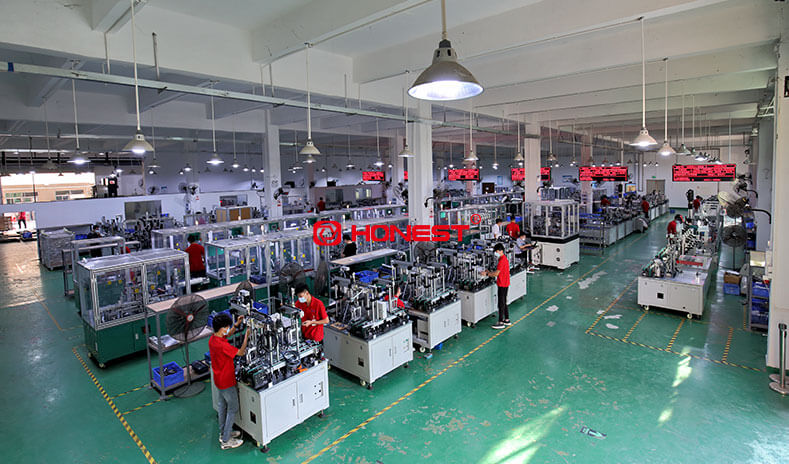
Taking HONEST Automation as an example, a leading Chinese motor automation equipment manufacturer, its practices in India effectively address the key pain points faced by multinational manufacturers:
Performance Close to Japanese and European Standards
HONEST Automation equipment achieves winding precision up to ±0.01mm, supported by in-house developed electronic closed-loop tension control and servo winding algorithms. It fully meets the stringent process requirements of new energy vehicle drive motors, automotive component motors (such as EPS and pump motors), and high-precision medical micro motors. The systems also support full MES integration for complete production traceability.
Key Advantage: Deep Localized Service in India
Unlike many equipment suppliers that “disappear” after export delivery, HONEST Automation has established a dedicated office in India and built a localized sales and after-sales technical team.
This means that when production issues arise in Indian factories, local engineers from HONEST can arrive on-site within hours—rather than waiting weeks for international dispatch. This fundamentally solves the critical pain points of imported equipment, such as difficult after-sales support and costly production downtime.
High Cost Performance
While delivering performance comparable to Japanese and European brands, HONEST Automation offers a more competitive pricing structure, significantly improving the return on investment (ROI) for multinational manufacturers establishing production bases in India.
4. Winding Machine Selection Decision Matrix for the Indian Market
We recommend using the following matrix to quickly evaluate and match equipment selection with your specific product requirements:
| Indian Local Brands | Japanese / European Brands | Top-Tier Chinese Brands (e.g., HONEST Automation) |
| Home appliances, toys, water pumps | Extreme specialty motors, well-funded premium projects | Automotive / Tier 1, NEV (New Energy Vehicles), Medical, High-end Industrial |
| Standard (≥±0.02mm) | Ultra-high (±0.005mm level) | High (±0.01mm level, meets automotive-grade requirements) |
| Weak; rarely supported | Strong; highly customizable and open | Strong; natively supported with open standard protocols |
| Low | Extremely High | Mid-to-High (Optimal cost-performance ratio) |
| Strong (Local presence advantage) | Very Weak (Slow response, extremely high costs) | Strong (local team, e.g., HONEST Automation) |
| ★★★☆☆ (Limited to low-end applications) | ★★★☆☆ (Limited to niche specialty applications) | ★★★★★ (Top choice for high-end manufacturing) |
5. FAQ
Q1: We are a Tier 1 automotive supplier in India. Can Chinese winding machines pass OEM PPAP audits?
A: Yes, absolutely. Taking HONEST Automation as an example, its equipment is already widely used in production lines of globally recognized automotive Tier 1 suppliers. The machines meet automotive-grade requirements, including precision, stability, and full data traceability compliant with IATF 16949 standards, and can effectively support customers in passing PPAP audits.
Q2: Is after-sales support for Chinese winding machines in India really reliable?
A: It depends on the supplier. Leading companies such as HONEST Automation have already established localized technical teams in India. When evaluating suppliers, it is essential to request a clear list of their local Indian engineers and a defined service-level agreement (SLA), rather than relying solely on commitments from agents or trading companies.
Q3: Why is after-sales service for Japanese and European brands in India often slow?
A: This is mainly due to cost and organizational structure. Senior engineers from Japanese and European manufacturers are typically based in their home countries. Travel to India involves longer visa processes and high daily overseas service costs. As a result, both suppliers and customers tend to avoid frequent on-site visits, relying instead on extended email communication, which can lead to prolonged production downtime.
Q4: We are in industries such as home appliances, toys, drones, and general industrial products. Our requirements for motor quality, competition pressure, and output are not very high. We plan to transition from manual to semi-automatic production lines. Is it necessary to use imported equipment?
A: In this case, it is advisable to first evaluate localized winding machine suppliers. If local manufacturers can fully meet your production requirements, they often provide a better overall balance of cost, output, quality, and service. Imported equipment is generally more suitable when you require fully automated, high-volume, and high-precision production, and when sufficient budget is available.
Q5: We supply motors to European, Japanese, and automotive OEM customers. How should we choose equipment?
A: If you require semi-automatic or fully automatic production lines, it is generally recommended to consider imported or high-end equipment brands. A practical approach is to start with prototyping, then move to single machines, semi-automatic systems, or full production lines step by step.
Chinese leading manufacturers and European/Japanese equipment suppliers typically offer higher stability and stronger upgrade and customization capabilities, making them more suitable for long-term investment.
When selecting a supplier, it is important to evaluate the following five key factors:
· Company scale and industry experience
· Strength of R&D and engineering team
· Track record with automotive customers
· Localized after-sales service capability
· Availability of spare parts and maintenance support for critical consumables