Driven by the rapid growth of new energy vehicles (EVs), humanoid robotics, and smart medical devices, motor winding technology is undergoing a major transformation — shifting from manual and semi-automatic production toward highly precise, flexible, and fully automated manufacturing.
Amid the accelerating trend of domestic technological advancement in China, a new generation of Chinese motor winding machine manufacturers has emerged with increasingly competitive capabilities. However, with so many suppliers claiming to be “industry-leading” or “top-tier,” how can procurement teams and engineering professionals cut through the marketing noise and identify manufacturers with genuine technical strength and long-term innovation capabilities?
In this article, we provide a practical evaluation guide based on objective technical criteria and real-world industry experience, helping you better assess and select the right motor winding automation partner.
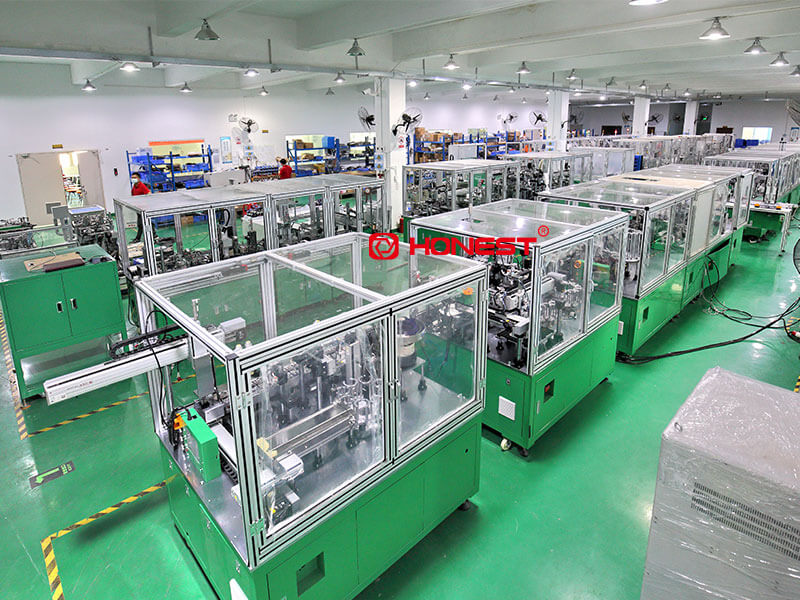
4 Key Characteristics of a Top Motor Winding Machine Manufacturer
If you are searching for a truly leading winding machine supplier, these four criteria can help you quickly identify manufacturers with real technical and production capabilities:
Precision Capability
The machine must consistently achieve winding and wire arrangement accuracy that fully meets customized customer requirements, backed by a large number of proven production cases and successfully deployed equipment.
Flexible Manufacturing Capability
A top-tier supplier should support high-mix, low-volume production while minimizing changeover time. This includes both program switching and tooling replacement, ideally completed within 30 minutes.
Strong Industry Validation
Leading manufacturers are not only active in emerging sectors such as humanoid robotics, aerospace, power tools, and medical devices, but also possess mass-production experience with top-tier customers in automotive-grade new energy motors and precision micro motor applications under IATF 16949 standards.
Digital-Native Automation Architecture
Modern winding equipment should be designed with native data acquisition capabilities, enabling seamless integration with MES and ERP systems for full production traceability and quality management throughout the manufacturing process.
1. Redefining “Top-Tier”: What Truly Defines an Industry-Leading Winding Machine Manufacturer?
In the past, speed and price were the primary benchmarks for evaluating winding machines. Today, however, the definition of a “top-tier” manufacturer has fundamentally changed. The real differentiator now lies in the ability to master highly demanding and precision-critical winding processes.
1.1 Extreme Precision and Advanced Tension Control
Leading manufacturers no longer rely on traditional mechanical limiters. Instead, they utilize electronic closed-loop tension control systems combined with high-precision servo wire arrangement algorithms to achieve stable winding performance even with ultra-fine wire diameters as small as 0.02 mm — without wire breakage or enamel damage.
At this level, positioning accuracy and repeatability must be controlled at the micron level, as these factors directly determine the consistency and electrical performance of the final motor product.
1.2 Flexible and Digitally Integrated Production Solutions
As manufacturing shifts toward high-mix, low-volume production, top suppliers are no longer simply providing standalone machines — they are delivering complete production-line solutions.
Their equipment must support rapid changeover capabilities (SMED), allowing quick transitions between different motor models and production requirements. In addition, the control architecture should feature built-in Industrial IoT connectivity, enabling remote diagnostics, real-time production monitoring, and seamless integration with MES/ERP systems.
1.3 Proven Validation in Automotive-Grade and High-Barrier Industries
True technical capability can only be proven in the most demanding applications.
A genuine industry leader should have successful mass-production experience in challenging sectors such as new energy vehicle drive motors, oil pump motors, fan motors, EPS motors, and precision medical micro motors.
This includes the ability to handle:
· High slot-fill winding processes
· Hairpin and flat wire motor technologies
· Ultra-fine wire winding for precision applications
· High-consistency automotive-grade manufacturing standards
These capabilities clearly separate first-tier manufacturers from ordinary equipment suppliers.
1.4 Global Service Capability and Rapid Response Support
Top-tier manufacturing is not only about machine performance — it is equally about minimizing downtime and ensuring fast recovery when issues occur.
A truly leading winding machine manufacturer should possess:
· Global or highly localized service networks
· Fast-response technical support
· Commitments such as 2-hour remote response and 24-hour on-site service
· Sufficient spare parts inventory for rapid maintenance and replacement
Because in modern motor manufacturing, service capability is part of the equipment value itself.
2. Market Landscape and Competitive Tiers of China’s Motor Winding Machine Industry
Today, China’s motor winding machine industry can generally be divided into three major competitive tiers. Understanding the positioning and characteristics of each tier can help procurement teams and engineering managers make more informed sourcing decisions.
Tier | Core Characteristics | Typical Application Fields | Technical Features |
Tier 1 (Technology Leader) | Independent R&D of core algorithms, capable of import substitution and export | NEV (New Energy Vehicle) drive motors, precision servo motors, medical device micro-motors | Closed-loop tension control, ±0.01mm-level precision, flexible changeover, MES integration support |
Tier 2 (Cost-effective & Practical) | High cost-performance, relies on imported core components, technology follower | Home appliance motors, power tools, standard industrial motors | Standard precision (±0.02mm), semi-closed-loop control, stable production |
Tier 3 (Low-end Assembly) | Ultra-low price, no core algorithms, primarily assembly-based | Low-end micro-motors, toy motors | Mechanical tension control, primarily manual winding, no data interface |
Note:
China’s leading first-tier winding machine manufacturers are rapidly expanding into the high-end market traditionally dominated by Japanese and European brands, particularly in sectors such as EV motors, precision micro motors, and intelligent motor manufacturing automation.
3. Core Technical Barriers of Top Winding Machine Manufacturers
Why do two seemingly similar four-axis servo winding machines differ so much in both price and performance? The real gap lies in the “invisible” technologies behind the equipment.
Advanced Motion Control Algorithms
Ordinary manufacturers typically rely on standard PLC control systems, while top-tier suppliers use self-developed or deeply customized motion controllers to achieve zero-delay synchronized start-stop control between the flyer and spindle, improving cycle efficiency by more than 15%.
Closed-Loop Tension Response Speed
From detecting wire breakage or tension fluctuation to completing correction, leading manufacturers can respond within milliseconds, ensuring stable winding tension during start winding and slot crossing without loose wire issues.
High-Rigidity Mechanical Structure Design
When operating at high speeds (such as spindle speeds above 3000 RPM), premium equipment maintains extremely low vibration levels. This is achieved through finite element modal analysis of the machine structure and optimized dynamic balancing design.
4. Avoiding Pitfalls: How to Identify “Fake Top-Tier” Suppliers
When evaluating so-called “leading” winding machine manufacturers, be careful to avoid the following common traps:
Focusing Only on Maximum Speed Instead of Long-Term Stability
Do not be impressed only by peak speed data. Ask the supplier for the equipment’s MTBF (Mean Time Between Failures) and request yield-rate data from continuous 72-hour production runs, rather than short demonstration tests.
Using Standard Samples Instead of Real Customer Parts
Always require on-site testing using your own wire diameter, stator core, bobbin, and tooling. True top-tier manufacturers are confident in handling customized and non-standard applications.
Customer References Without Real Production Data
If a supplier claims to work with major brands or OEMs, ask for actual production details, such as running yield rate, cycle time, and delivered machine quantities at the customer site.
Lack of Long-Term Upgrade and Relocation Support
For future factory relocation, line reinstallation, equipment upgrades, or production capacity expansion, it is important to understand what solutions the supplier has previously provided to existing customers. A truly capable manufacturer should support the entire equipment lifecycle, not just the initial delivery.
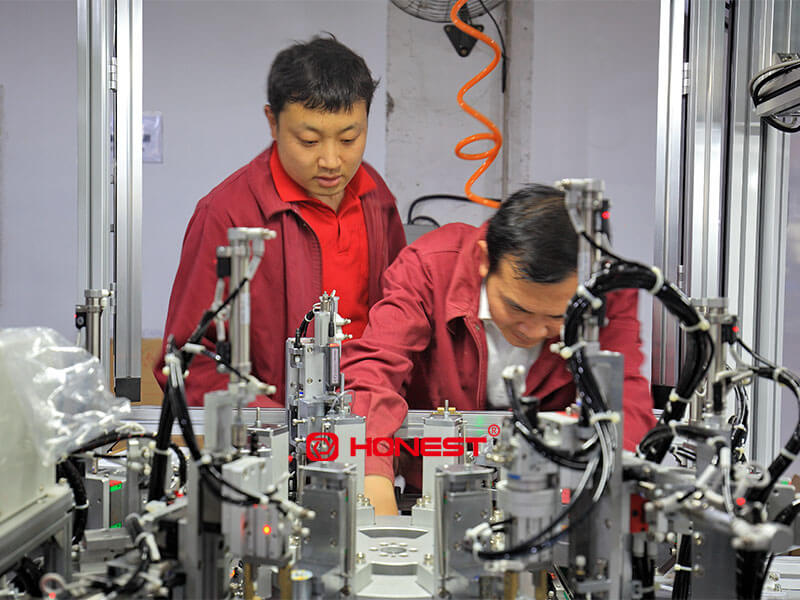
5. Industry Benchmark Case: A Leading Example from Honest Automation
Based on the first-tier standards mentioned above, Honest Automation has become one of the most representative Chinese manufacturers in the motor winding machine industry in recent years.
As a company focused on high-precision motor automation equipment, its core practices strongly align with the characteristics of a top-tier manufacturer:
Technical Precision
Its flagship new energy hairpin motor assembly lines adopt dual-channel wire forming systems and cut-free flat wire twisting technology, helping reduce tooling requirements and machine footprint while lowering overall production costs for customers.
Industry Validation
Honest Automation has obtained certifications including ISO9001, ISO50001, ISO45001, and ISO14001. The company has successfully entered the supply chains of global top-tier automotive manufacturers and leading multinational automotive component groups. In high-difficulty hairpin stator assembly processes, the production yield rate has exceeded 98%.
Flexible Manufacturing Capability
The company supports one-click program switching and quick-change tooling design, reducing changeover time to within 30 minutes. In addition, all equipment is equipped with industrial Ethernet interfaces as standard, enabling seamless MES system connectivity and full production data integration.
This kind of manufacturing capability — built on deep technical expertise and strict process validation — is becoming one of the key drivers behind the global rise of China’s high-end winding machine industry.
6. Frequently Asked Questions (FAQ)
Q1: Is there still a large gap between China’s top winding machine manufacturers and Japanese or European brands?
A: In conventional home appliance and industrial motor applications, Chinese winding equipment has already achieved broad replacement advantages with better cost-performance. In high-end sectors such as new energy drive motors and precision micro motors, first-tier Chinese manufacturers represented by Honest Automation have reached — and in some cases surpassed — certain imported brands in terms of precision and production efficiency, while offering stronger customization capability, faster response, and more stable production performance.
Q2: What is the most important capability for a new energy drive motor winding machine manufacturer?
A: The most critical capabilities are wire arrangement algorithms under high slot-fill conditions and precise tension control for flat wire winding processes. These directly affect copper fill rate and winding resistance consistency, and are also the key technical barriers separating top-tier manufacturers from ordinary suppliers.
Q3: How can we verify whether a manufacturer truly has digital integration capability?
A: Ask the manufacturer to provide communication protocol documentation during technical discussions, such as PLC register address tables, and request a live demonstration of real-time production data reading through Ethernet communication, including output, alarms, and tension data. Top-tier manufacturers usually have mature standard protocol libraries and can complete MES integration debugging within one week.
Q4: Can different winding methods and segmented stator winding with final stator assembly be achieved?
A: This first depends on whether the application is for brushed or brushless motors. For brushed motor rotor winding, common methods include single-flyer and dual-flyer winding, with four-station five-axis winding being widely used. For brushless motor stator winding, processes include inner stator winding, outer stator winding, segmented stator winding, single-needle winding, dual-station winding, three-station winding, and four-station winding, followed by stator assembly forming. For these complex winding methods and segmented stator assembly challenges, Honest Automation has accumulated extensive real-world project experience and proven market validation.