The journey of a humanoid robot from a functional prototype in a research lab to a commercial product on the factory floor is one of the most complex manufacturing challenges of the 21st century. The core hurdle is no longer just about making the robot walk; it is about producing thousands of units with micrometer precision, high reliability, and drastically reduced costs. To achieve this, automation cannot be an afterthought—it must be integrated across the entire lifecycle. Here is a comprehensive look at humanoid robot manufacturing automation, from design to mass production.
Phase 1: Design for Manufacturing (DFM) and Prototyping
The transition to mass production begins before the first physical part is ever made. If a humanoid robot is designed solely for performance without considering how it will be assembled at scale, automation becomes impossible.
The Role of Digital Twin in Early Validation
Modern manufacturing relies heavily on Digital Twin technology. Before physical tooling is cut, engineers create a virtual replica of both the robot and the production line. This allows manufacturers to simulate complex processes—such as the path of an automated winding needle or the force required to press-fit a joint actuator—in a zero-risk environment. By validating these processes digitally, manufacturers drastically reduce the physical iteration time and avoid costly tooling mistakes.
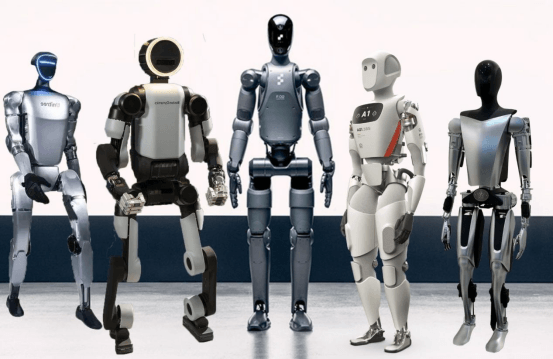
Rapid Prototyping vs. Scalable Design
In the prototyping phase, 3D printing and manual assembly are standard. However, these methods are not scalable. DFM (Design for Manufacturing) principles must be applied to ensure components can be mass-produced. For example, motor housings must be designed for automated CNC machining, and stator designs must accommodate high-speed automated wire winding without risking insulation damage.
Phase 2: The Core Component Manufacturing Phase
The true test of mass production capability lies at the component level. In humanoid robotics, joint actuators (comprising motors, reducers, and sensors) account for over 60% of the manufacturing complexity and cost. Automating this phase is the critical foundation of the entire supply chain.
Joint Actuator Motor Production
A single humanoid robot utilizes 40+ high-performance joint motors, primarily frameless torque motors for larger joints and hollow cup motors for dexterous hands. Manual winding and assembly introduce human error and inconsistency, making them unviable for commercial scaling.
To achieve scalable manufacturing, specialized motor automation production lines are deployed. Equipment providers like HONEST Automation implement turnkey automated solutions that handle the entire motor manufacturing process:
Stator Manufacturing: Automated paper insertion, precision multi-strand winding, and automatic twisting/soldering to maximize the copper fill factor, directly impacting motor torque density.
Rotor Assembly: High-speed automated magnet insertion and magnetization, followed by dynamic balancing to prevent vibration at high RPMs.
Micro-Meter Assembly: Automated press-fitting of the rotor into the stator, maintaining precise, uniform air gaps to prevent torque ripple and ensure smooth robotic articulation.
By establishing this foundational automated process, manufacturers can drive down the per-unit cost of actuators, moving humanoid robots from expensive prototypes to commercially viable products.
Precision Reducer and Sensor Assembly
Alongside motors, harmonic and planetary reducers require highly automated, cleanroom-level assembly lines. Automated systems handle the precise meshing of flexsplines and circular splines, while machine vision ensures force sensors are calibrated and aligned to micrometer tolerances.
Phase 3: Sub-System Assembly and Integration
Once core components are validated, they must be assembled into functional sub-systems (e.g., a robotic arm or a leg).
.png "Humanoid robots (2).png")
Automated Actuator Integration
In this stage, the manufactured motor, reducer, and encoders are automatically combined into a single actuator module. Automated guided vehicles (AGVs) deliver the components to robotic assembly stations, where 6-axis robots equipped with force-torque sensors perform the precise pressing and fastening. This ensures that every actuator module has identical mechanical characteristics, which is crucial for the robot’s control algorithms.
Limb and Torso Assembly Lines
Sub-system assembly involves attaching actuator modules to structural carbon fiber or aluminum castings. Collaborative robots (cobots) work alongside automated fastening systems to apply consistent torque to every bolt, preventing future mechanical loosening. Automated dispensing systems apply structural adhesives for joints that require high rigidity without the weight of mechanical fasteners.
Phase 4: Final Assembly, Calibration, and EOL Testing
The final phase is where the humanoid robot is fully realized, tested, and prepared for deployment. This stage requires a blend of high-payload automation and ultra-precise measurement.
Full-System Integration
The limbs, torso, head, and computing hardware are brought together on the final assembly line. One of the most challenging automated processes here is cable routing and harness connection. Advanced robotic arms utilizing AI-driven 3D vision are increasingly being used to route delicate wiring through the robot’s compact chassis, mimicking the dexterity of human hands.
AI-Driven Calibration and EOL Testing
Once assembled, the robot must be calibrated and tested. End-of-Line (EOL) testing stations automate this entirely:
Zero-Position Calibration: The robot is placed in a rig where automated systems measure the exact offset of every joint encoder, writing calibration data directly to the robot’s controller.
Friction and Torque Ripple Compensation: The robot runs through programmed motion paths while automated sensors measure mechanical resistance, allowing software to compensate for manufacturing variances.
Vision Inspection: AI cameras inspect the final unit for cosmetic defects, ensuring the exterior meets commercial standards.
The Critical Transition: Scaling from 1 to 10,000 Units
The leap from building a few hundred units to tens of thousands requires more than just fast machines; it requires absolute control over the manufacturing process.
Yield Rate Management
In a system with 40+ motors and hundreds of gears, a 95% yield rate on individual components can result in an unacceptably low final yield. This is why achieving 98%+ yield rates on foundational processes—like the automated motor winding and assembly lines provided by specialists like HONEST Automation—is mathematically essential for mass production viability.
MES and Traceability
Modern automated lines are governed by Manufacturing Execution Systems (MES). Every actuator, motor, and structural part is assigned a serial number and tracked via RFID or QR codes. If a batch of stator wire is found to be defective, the MES system can instantly identify exactly which robots on the assembly line used those parts, halting production or initiating a targeted recall. This level of traceability is non-negotiable for industrial and consumer safety.
Automation as the Enabler of Commercial Viability
The commercialization of humanoid robots is not just a software and AI problem; it is fundamentally a manufacturing challenge. From applying DFM principles in early design to deploying high-precision motor automation lines and AI-driven EOL testing, automation spans the entire lifecycle. As the industry scales, the partnership between robot developers and specialized automation equipment providers—those who deeply understand the nuances of actuator manufacturing—will be the ultimate deciding factor in who successfully brings humanoid robots to the masses.
Case Study: Honest Automation’s End-to-End Solutions for Humanoid Robotics
To understand how this full-lifecycle automation is applied in reality, we can look at Honest Automation, a leading global provider of intelligent manufacturing equipment. Honest Automation has established itself as a pivotal Tier-0.5 equipment supplier in the humanoid robotics space, delivering end-to-end automation solutions that bridge the gap between prototype design and mass production.
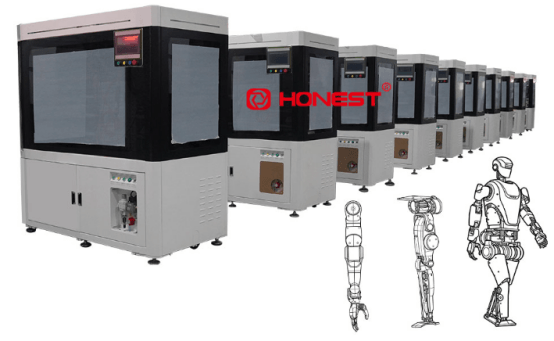
Their comprehensive portfolio covers the entire manufacturing value chain, specifically tailored for humanoid OEMs:
Frameless Torque Motor Assembly Lines: For the main hip and knee joints, Honest Automation provides highly automated, turnkey production lines. These lines handle the delicate micro-meter level assembly of frameless motors, integrating automated stator winding, precision magnet insertion, and dynamic rotor-stator press-fitting. This ensures the ultra-tight air gaps required for high torque density and smooth articulation.
Hollow Cup Motor Prototyping and Winding Machines: For the dexterous hands of humanoid robots, hollow cup motors are essential due to their compact size and zero cogging. Honest Automation supplies specialized rapid prototyping equipment and high-speed winding machines specifically designed for the intricate, tension-sensitive winding of hollow cup motors, ensuring high yield rates even during the R&D and small-batch phases.
Joint Actuator (Gearbox) Assembly Lines: Beyond the motor, Honest Automation delivers automated assembly lines for the complete joint actuator module. These systems precisely integrate the motor, harmonic/planetary reducers, encoders, and braking mechanisms into a single, tested unit, ready for chassis mounting.
Complete Humanoid Robot Final Assembly Lines: At the system level, Honest Automation designs and builds the final box-build assembly lines. These flexible manufacturing cells utilize collaborative robots, AI-driven 3D vision for cable harness routing, and automated fastening systems to construct the torso, limbs, and head, culminating in fully automated End-of-Line (EOL) calibration and testing.
By providing everything from single-station winding machines to complete humanoid robot assembly lines, equipment providers like Honest Automation are actively dismantling the manufacturing bottlenecks of the robotics industry. Their deep process expertise in joint motor manufacturing proves that scalable, cost-effective mass production of humanoid robots is not just a future concept, but an accessible present-day reality.