A stator winding equipment can improve motor production efficiency by stabilizing cycle time, reducing repetitive manual operations, improving winding repeatability, and supporting integration with inspection and assembly processes. The real productivity gain comes from stable production performance rather than winding speed alone.
Production Efficiency Is More Than Winding Speed
When manufacturers compare stator winding machines, winding speed is often one of the first specifications they look at.
However, actual production efficiency is determined by much more than how quickly the winding head moves.
A machine with a very high winding speed may not deliver high output if operators spend significant time loading and unloading parts, adjusting the machine, dealing with wire breaks, or correcting quality problems.
For mass production, stable cycle time and consistent process performance are often more valuable than achieving the highest theoretical winding speed.
Stable Cycle Time Makes Production Easier to Manage
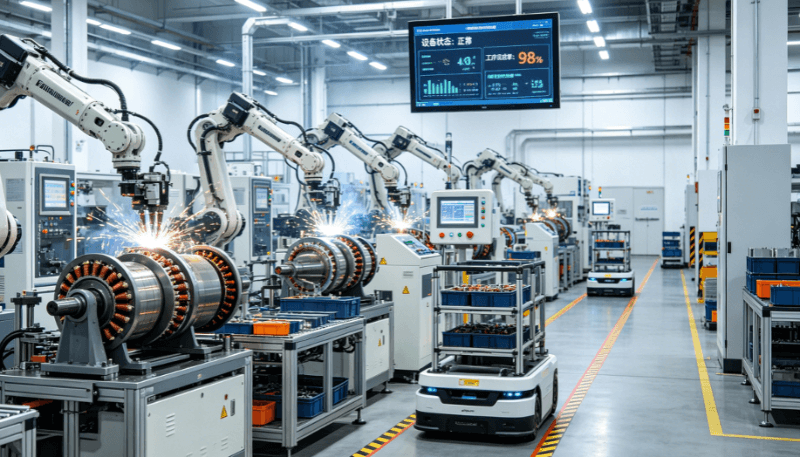
A stator winding machine can perform the winding process according to predefined parameters. Once the process has been validated, the equipment can repeat the same operating sequence from one stator to the next.
This helps manufacturers establish a more predictable production rhythm.
Stable cycle time makes it easier to calculate daily capacity, schedule manpower, plan material supply, and coordinate upstream and downstream processes.
For automotive motor manufacturers, this becomes particularly important because winding is usually only one process within a larger manufacturing line.
If winding time changes significantly from one cycle to another, it can affect the balance of the entire production line.
Automation Reduces Repetitive Manual Operations
Manual winding requires operators to repeatedly position the stator, guide the wire, control winding, and complete other process steps.
A winding machine can automate many of these repetitive actions.
This reduces operator dependency and allows production workers to spend more time monitoring equipment, managing materials, and handling quality control.
The benefit is not simply saving labor. Reducing repetitive manual operations can also make the production process more predictable.
When the same process is performed using defined machine parameters, there are fewer opportunities for variations caused by fatigue, experience level, or individual working methods.
Winding Consistency Affects Overall Efficiency
Quality and efficiency are closely connected.
If winding quality is unstable, manufacturers may need additional inspection, rework, or even scrap handling. These activities consume production capacity even though they do not create additional products.
For example, inconsistent wire tension may cause irregular winding. Incorrect wire positioning may create problems during subsequent assembly. A wrong number of turns can also affect motor performance.
An automated winding machine can control these parameters more consistently and help reduce process variation.
Therefore, productivity should not be measured only by units produced per hour. Yield and process stability should also be included.
Integration Can Create a Larger Efficiency Gain
A standalone winding machine can automate the winding operation, but greater efficiency can often be achieved when the equipment is integrated into a production line.
Automatic loading can transfer stators into the machine without continuous manual handling. Automatic unloading can send finished parts to the next process.
Inspection systems can also be connected to the production process. Depending on the motor application, manufacturers may integrate electrical testing, dimensional inspection, or other quality checks.
This creates a more continuous manufacturing flow.
The objective is to reduce unnecessary handling between processes and keep the production cycle stable.
Changeover Time Also Matters
Many motor manufacturers do not produce only one motor model.
When several stator models are manufactured on the same equipment, changeover time can affect overall efficiency.
A machine that takes a long time to change tooling may lose significant production capacity, especially when production batches are relatively small.
For this reason, manufacturers should evaluate not only the standard cycle time but also how easily the equipment can switch between compatible products.
Programmable recipes, suitable tooling design, and standardized changeover procedures can help reduce unnecessary downtime.
Equipment Stability Is Part of Productivity
Machine uptime is another important factor.
If equipment frequently stops because of wire breaks, sensor problems, mechanical adjustment, or other issues, the theoretical cycle time becomes less meaningful.
A production machine should therefore be evaluated over a longer period rather than based on a short demonstration.
Manufacturers should ask how the machine performs during continuous operation, how maintenance is handled, what spare parts are required, and how quickly technical problems can be resolved.
For high-volume production, stable equipment often creates more value than a machine that is only fast under ideal conditions.
How Should Production Efficiency Be Evaluated?
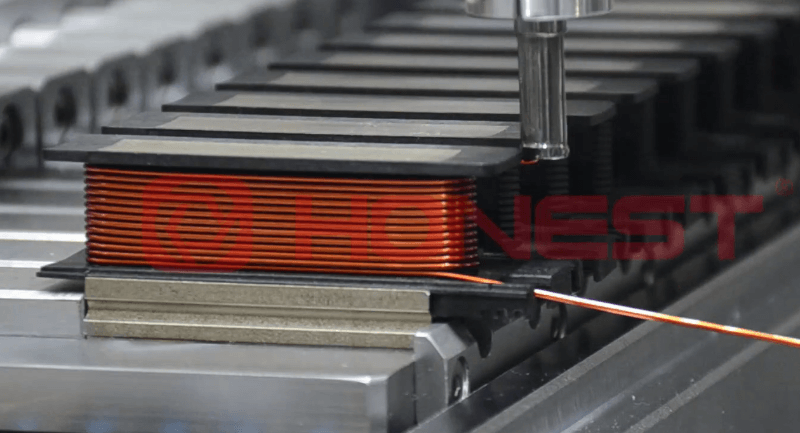
A practical evaluation should include several factors: cycle time, equipment uptime, yield, changeover time, labor requirements, and integration with other processes.
For example, two machines may both have a 20-second winding cycle. If one requires significantly more manual handling or has more downtime, its actual production output may be lower.
This is why production efficiency should be evaluated at the process or line level rather than from one machine specification.
Automation Should Follow the Production Process
Not every manufacturer needs the same level of automation.
For low-volume production, a semi-automatic winding machine may provide sufficient efficiency while maintaining flexibility.
For high-volume automotive or industrial motor production, fully automatic winding and integrated production systems may provide greater value.
The important point is to start with the manufacturing target and then determine the appropriate automation level.
FAQ
1. Does a faster winding machine always increase production output?
No. Actual output also depends on loading, unloading, changeover, downtime, quality, and other production factors.
2. Can winding equipment reduce labor requirements?
Automation can reduce repetitive manual operations and operator dependency, although workers are still needed for machine operation, material management, maintenance, and quality control.
3. How can winding equipment improve production yield?
By controlling parameters such as wire tension, winding position, turns, and process sequence more consistently, the equipment can help reduce process variation and related quality problems.
The efficiency benefit of a bldc motor stator winding machine is not simply that it winds copper wire faster. Its greater value comes from creating a more stable, repeatable, and controllable manufacturing process.
For motor manufacturers, the right evaluation should include cycle time, yield, uptime, labor requirements, changeover, and production-line integration.
HONEST Automation develops customized stator winding and motor production equipment based on these factors, helping manufacturers build production processes that are designed for stable long-term operation rather than short-term speed alone.