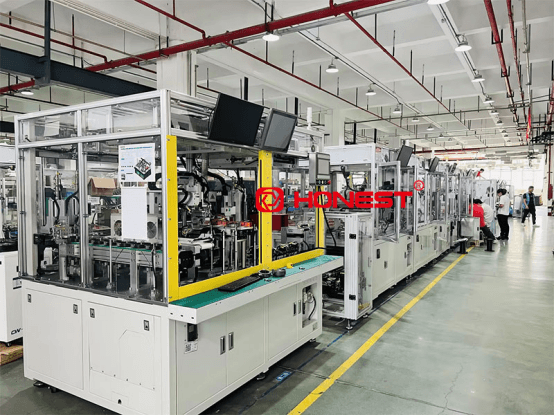
When it comes to driving in the rain, a car’s wiper motor is more than just a component—it’s the “guardian of visibility.” Its assembly quality directly affects how smoothly your wipers operate, how much noise they make, and how long they last.
For many automakers and motor manufacturers, one question often comes up: what exactly happens on a standard wiper motor assembly line?
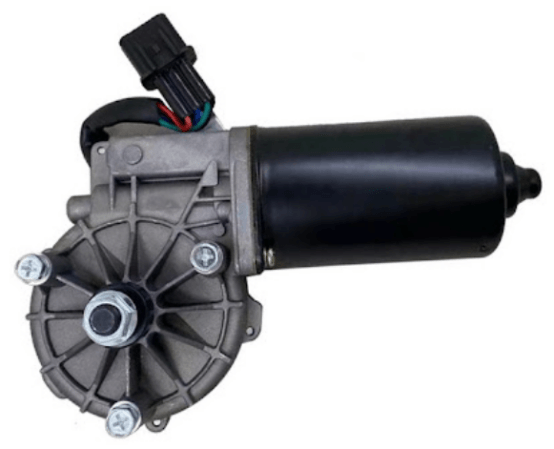
At Honest Automation, we specialize in tailored automated production lines for wiper motors, window lift motors, and seat motors. In this article, we take you step by step through the complete wiper motor assembly process—from component feeding to finished product output—revealing the full workflow behind every reliable wiper motor.
Wiper motor assembly lines typically use semi-automatic or fully automated flexible production systems, allowing both high-volume manufacturing and customized production for different models of the same wiper motor. The assembly process is divided into five key modules: rotor (armature) assembly, stator (housing) assembly, final assembly, performance testing, and aging & packaging. Each module is closely interconnected—skipping any step could compromise the quality and reliability of the finished motor.
1. Component Feeding and Preprocessing (Laying the Foundation for Quality)
The first step in assembly is thorough preparation to prevent defective components from entering subsequent processes, ensuring a solid foundation for high-quality assembly.
Material Feeding: All components—including rotor cores, commutators, bearings, magnets, housings, end caps, gearboxes, worm gears, worm wheels, seals, brushes, and screws—are fed automatically using automated equipment. This approach is efficient, convenient, and minimizes errors caused by manual handling.
Visual and Dimensional Inspection: Machine vision technology is used to accurately detect surface defects (such as scratches or damage) and dimensional deviations for each component. Defective parts are automatically removed to prevent them from compromising downstream assembly quality.
Gluing and Lubrication: Critical areas such as bearing seats, magnet slots, and sealing surfaces receive precise glue application and lubrication through automated equipment. This not only improves sealing between components but also reduces friction during operation, extending the motor’s service life.
2. Rotor (Armature) Assembly – The Power Core of the Motor
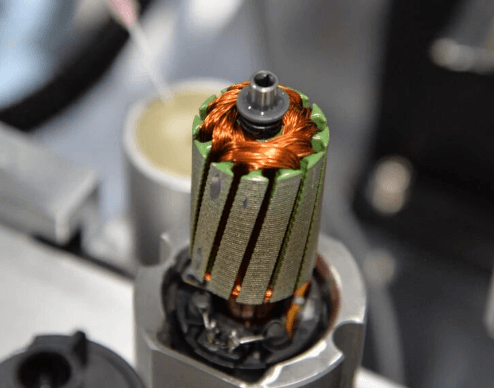
The rotor serves as the “heart” of a wiper motor, and its assembly precision directly affects power output and operational stability. Every step must be carefully controlled.
Commutator Press-Fit: The commutator is precisely pressed into the designated position on the armature shaft, with strict control of press-fit force and alignment to ensure stable winding and electrical performance.
Armature Winding: Using fully automated winding machines, enameled wire is accurately wound onto the rotor core. Winding turns and tension are tightly controlled to prevent loose coils or wire slippage, ensuring reliable electrical performance.
Lead Soldering: The winding leads are firmly welded to the commutator copper bars using spot welding or fusion welding, ensuring solid contact, stable resistance, and eliminating cold or false solder joints that could cause motor failure.
Turning and Dynamic Balancing: The commutator outer surface is precisely turned to ensure roundness, while the rotor is dynamically balanced to minimize vibration and noise, enhancing smooth operation.
Rotor Testing: High-voltage insulation tests, DC resistance measurements, and inter-turn voltage withstand tests are conducted to fully assess winding electrical performance and filter out non-compliant rotors.
Bearing and Spacer Assembly: Front and rear bearings, circlips, and spacers are precisely installed, with strict control of axial clearance to ensure smooth rotor rotation without jamming.
3. Stator (Housing) Assembly – The Magnetic Core of the Motor
The stator works in tandem with the rotor to generate driving force. Its assembly quality directly determines the magnetic field strength and operational efficiency of the motor, making this process equally demanding.
Housing Preparation: Bearings are precisely pressed into the end caps on both sides of the housing to ensure secure installation and a tight fit.
Magnet Installation and Magnetization: Adhesive is applied to the inner wall of the housing, and magnets are automatically placed using automated equipment. The glue is then cured with UV light to firmly secure the magnets. Finally, the installed magnets are strongly magnetized to create a stable stator magnetic field.
Brushed Holder and End Cap Assembly: The brush, spring, and brush holder assembly are accurately installed, and sealing rings are pressed in place to enhance the stator’s sealing performance, preventing dust and moisture from entering.
4. Final Assembly Line: Motor and Gearbox Integration
Once the rotor and stator assemblies are complete, components move to the final assembly stage, where the motor is integrated with the gearbox to form a complete wiper motor.
Motor Assembly: The rotor assembly is precisely inserted into the stator housing, and end caps are secured to ensure rotor-stator coaxial alignment, preventing friction or jamming during operation.
Screw Fastening: Screws are automatically tightened using electric screwdrivers (or EC wrenches) to the specified torque, ensuring uniform fastening without loosening, and maintaining the structural stability of the motor.
Gearbox Assembly: The worm, worm wheel, output shaft, and limiter are sequentially installed. Gear oil or grease is applied inside the gearbox to reduce wear, followed by the installation of the sealing cover and circlip to prevent axial movement and lubricant leakage.
Final Pressing/Riveting: The motor housing and gearbox are precisely pressed or riveted together, ensuring a secure connection and maintaining waterproof sealing to prevent moisture from entering the motor during rainy conditions.
5. Critical Quality Control: Online Performance Testing (Preventing Defective Products from Leaving the Factory)
After assembly, each motor undergoes rigorous performance testing to ensure it meets factory standards. This is a crucial step in guaranteeing product quality.
Functional Testing: Motors are powered on to verify high- and low-speed operation and reset functionality, while monitoring noise, current, and torque to ensure all parameters meet design specifications and the motor runs smoothly without anomalies.
Sealing Test: Air-tightness testing (waterproof testing) is performed to verify the motor’s resistance to water ingress, preventing damage during rainy conditions.
Visual Inspection: Machine vision systems are used again to inspect the motor’s exterior, ensuring there are no scratches and all components are properly assembled, confirming the product meets visual quality standards.
6. Automotive Wiper Motor Assembly Line Solutions and Case Studies
HONEST Automation provides automotive wiper motor assembly lines, including both semi-automatic and fully automated solutions. We have successfully delivered batch production lines to numerous automotive and motor manufacturing companies. Contact us to request a production line solution and a quotation.